

FURRYDOC: On behalf of disaffected physicians and Jews, there are some naked emperors that need some exposure. Some might call this the beneficial application of Sinat Chinam
Friday, October 18, 2019
200,000 Miles
I've never had a car that made it to 200,000 miles before. It was purchased with 36,000, either a returned lease or maybe a rent-a-car, but it has served me well for about ten years. It made it to the aspired 200K. It's still comfortable, cluttered insided, and to the best of my knowledge with all safety features functional. If I want to be somewhere, it gets me there reliably. And I don't have to budget for a replacement yet. Cheers to my 2007 Honda

Thursday, October 17, 2019
Two Americas Reaches the Doctors
I avoid political opinions on my blog but sometimes they are a chance to think an issue through.
Usually the WSJ boots me as an inferior non-subscriber but they let me look at this one on FB where an assigned FB Friend must have either posted it or commented on it. There have been a couple of popular books on this. Charles Murray's Coming Apart analyzed a 50 year trajectory of separation having to do less with political identification but more with economic circumstances. He was rather condescending to the underachievers, as I might anticipate from other writings that suggest colleges are too often attended by students not academically qualified to be there, but noted that economic distress also clustered with divorce, housing instability, educational underperformance, and jeopardized health that filtered over generations. Most of the analyzed 1960-2010 span did not have political divide as part of the cluster. Robert Putnam's Our Kids looks at similar data in a more sympathetic way. The economically stressed were looked at as displaced rather than as underachievers, but with the same bimodal result as the WSW article, complete with political division and with isolation of each group from the other. It's really a megatrend. In his book Tailspin Steven Brill notes that historically public officials anticipated this possibility decades ago and even debated protections to those who would be predictably displaced but those got sidetracked in the name of expediency. And as America divides with a political, social, and economic intersectionality, one group does not readily cross over to the other. Economic data from the WSJ indicates that prosperity follows Democrats while those displaced from their traditional niche default as Republicans. The divisions are not equal by any measure, nor is the hostility equal.
Doctors puzzle me a little in this framework. Sermo has largely devolved into a right wing echo chamber though the physicians I would suspect are more personable in person than on an unedited screen. They don't seem to be at the top of the medical food chain, often bitter posting individuals who never were granted the Hebrew chayn, which is best English translation may be grace. They all have university educations, mostly high income, public respect, and mostly secure lives. Yet they come across as pounced upon by the forces they cannot control, be it the government, the insurers, bosses who are less accomplished than themselves. The optimism seems absent as does the joy that taking care of patients once created for them. The divide in general may be economic. The divide among the doctors may be one of perceived trajectory as well as whether the daily work brings gratification in sufficient amounts to overcome the annoyances. They do good work but it does not seem to them to be its own reward. Since the divide involves prosperous professions, it should include the sense of loss of security or future prospects as part of the intersectionality. I don't detect that same bitterness from the senior physicians, either at work or at professional meetings. Just as we don't seem to cross categories based on prosperity or struggle, we don't cross them based on personal bitterness or satisfaction either. Irrespective of professional or economic circumstances, if you perceive yourself as trampled, you probably are. It may challenge the medical workplace for some time to come.
|

Monday, October 7, 2019
Mid-point Assessment
 Since my personal goals are established semi-annually, twelve per cycle, at new year and at mid-year, the halfway point on the current twelve has arrived. I did a little better than average. I wanted to purchase a new mattress as the current one sags enough to impair sleep. This calendar year I have stayed at a few hotels and can tell the difference. I looked casually at IKEA and a few other places, priced on-line options, but have not purchased. I will after the yom tovim. Clearing the basement is my biggest tangible project. I have made progress but will need to hire help with clutter removal. It is really part of a grander aspiration to have a single storage place for our things, eventually moving items out of our rented storage unit. My energy to this waxes and wanes. Time needs to be scheduled as I did for creating My Space, though with far less motivation.
Financial review has gone on schedule. My goal has been to do it with no action needed.
My children live an airplane ride away. I plan to visit each. St. Louis done. California by year's end. It's a very tangible project with clear end points and a certain pleasure to its pursuit.
My personal efforts are also mostly more tangible and measurable than they have been in advance. I read my assigned three books and then some. I've seen two movies on TV, one of two in the theater, leaving one more to go in the theater, which I can do after the yom tovim. I have visited two old friends from high school, both in metro NY. My three day trips included the Galer Winery in Pennsylvania, the Nemours Mansion in Delaware, and the Rockland Bakery in New York, none of which I had been to previously.
The remaining tasks may be harder to fulfill. My weight would be better if about 10 pounds less. I use weight as a measure, but it's really more of a process to promote my health. Diet restriction has hit a lull. I was eating breakfast every day for a while but gained a few pounds in the process. I changed it to two meals a day which has gone better. No snacks from 8PM to 6AM, based on research by a metabolism guru at U Colorado, has been reasonably consistent though not perfect. Exercise was doing very well for a while, then sidelined following an appendectomy, then limited in the early morning by arthritic stiffness. My consistency to moving it later in the day has been hampered by my OLLI schedule and I have not been able to recapture the intensity. Still, weight remains the best objective surrogate of progress, even if the real but more difficult to measure goal is stamina and energy.
I had planned to do something beneficial for my synagogue, though I'm not convinced they want anyone other than the people already engaged to create anything new. I asked the Rabbi in the past how I might advance the congregation. He suggested I come to minyan more. To be fair, I've hardly done dick, and counting in the minyan requires dick but his vision of congregational advancement seems much more shallow than mine. I'll give it another go with the President and Rabbi and maybe some past Presidents after the yom tovim.
Then the two I probably won't do, develop a web site and write the book that makes me famous. Writing has been on the list before in several forms. And I do write well, but in spurts. The web site got as far as initial inquiry. I don't really have a good enough purpose for having one, though a more interactive blog with my own format could justify this. Revisit by year's end.
So there's how twelve projects plod along, a little at a time. All are doable except the Great American Novel, and even there if I believed in myself more I have the capacity to do that. Some are done or almost done. What interested me three months ago does not always sustain itself, so these are best approached as assignments rather than self-sustaining insatiable initiatives. Most have a measurable end point.
As retirement makes the days more amorphous, the "should do today" list doesn't have any external imposition or any feedback other than what I offer myself. Halfway through this cycle, doing OK.
Thursday, October 3, 2019
Cuisines
Among my Osher Lifelong Learning Institute courses for this semester is one on the history or food, which is not what it is really about. A more accurate description would be a list of recognizable cuisines from different geographic districts of Western Europe. Thinking like an American, a Kosher one at that, makes the understanding of this more difficult. I have no regional cuisine, as much as making an elegant dinner, as I did for Rosh Hashana, challenges me. My 23 and Me profile has me unequivalently identified as Ashkenazic origin, as were my grandmother's culinary roots, but I have been imprinted by cookbooks and diverse availability of food. Since my dietary restrictions keep me from sampling a lot of restaurants, anything of meat origin has to be made at home. I make Hamburgers, meat loaf, clops from ground beef, chicken in every which way, steaks that would pass in Texas, and stew as cholent or hamin. Desserts are usually baked. I've made linzertorte with no idea of its Austrian origins, apple walnut pie and oatmeat chocolate chip cookies of Philadelphia lineage, and torta del rey from an Italian Kosher cookbook. Baklava is a lot of work, but I've done it. Apple strudel may be overdue. Fish is what they have at Shop-rite which becomes gravlax, seared tuna or coulibiac. They each have a regional origin, but importation of ingredients and availability of recipes has undermined any authenticity.
I suspect the regional European cuisines have similar challenges to authenticity. In this era of Autobahn and Aldi's, to say nothing of German populations shifts of two world wars, I think my skepticism of what distinguishes Munich from Cologne is justified. Borders have been historically fluid. Is Swiss chees made in Switzerland really better than Swiss cheese made commercially in Wisconsin? In America where about half the Kosher restaurants are Chinese, the proprietors and chefs are not. I would expect that a German or French restaurant of the upper echelon in America would be founded and run by somebody who trained in those regions rather than a native. And the people preparing the food are as likely to be undocumented people keeping a low profile as trained chefs trying to have their own place one day.
I guess there are some regional ingredients that survive. Crabs from the Chesapeake, gooey butter cake which I've not seen on a menu outside St. Louis despite its ease of preparation, abalone that I have only seen on menus in California. But mostly we have commercial agriculture and ranching, refrigerated shipping and rail cars, reality TV of megaharvests of whatever in the Bering Sea. Purity of cusine is just hard to sustain.
Friday, September 27, 2019
Don't Really Want Anything
Long afternoons appear most days. Sunday morning, previously Me Time, has been absorbed to other open times since retiring. On a chronic basis, I would start the day at the local Brew HaHa with a large porcelain mug of their dark roast blend, fortified with a dash of half & half, shake of either Cinnamon or nutmeg, and sometimes a packet of brown sugar. Then once it is confirmed that the table doesn't wobble, I would set down the mug and open up my weekly planning kit. More often than not I would complete the plan before the coffee, leaving me with a few minutes to surf the web on my tablet. Next stop most weeks, the Target Store. I rarely bought anything but started at Mens Clearance, then Mens, then onward to kitchen ware and small appliances. On the way in I would look at the weekly ads that they posted on the entrance, but even on sale, other places had better prices. Then home. Often later in the day I would go to a different store: Boscovs or TJ Maxx for clothing, Shop-Rite or Trader Joe's for groceries, Total Wine for tasting and maybe purchase, Cabelas to see what fishing gear they had on sale, or the New Castle Farmers Market for a haircut and tour of the Chinese discount store. I needed very little, wanted a little more, but rarely indulged except if there were a really good deal on shoes in my hard to find size. Retirement has not changed my needs but it has largely obliterated my wants, so much so that my presence in any store other than periodic grocery shopping has plummeted.
Not that I ever found puttering around the stores a disheartening experience. It was a diversion from work, how I might take some of what I earned out of storage and convert it to tangible goods or satisfy the few wants that I had. Now it's different. I just don't want anything and don't seek out a prompt of what I might want but don't realize yet. It's better this way.

Not that I ever found puttering around the stores a disheartening experience. It was a diversion from work, how I might take some of what I earned out of storage and convert it to tangible goods or satisfy the few wants that I had. Now it's different. I just don't want anything and don't seek out a prompt of what I might want but don't realize yet. It's better this way.
Friday, September 13, 2019
Learning Mah Jongg
Our branch of the Osher Lifelong Learning Institute offers a series of classes, some at a university level, as my class on vaccinations taught by a retired university biology professor, some at the pitch the political hardball level, and some better classified as recreation. I try to nurture a new exposure, with the likely false hope that it will become an interest. Woodcarving did not. This semester, it's Mah Jongg. I am not the only male in the class, but we are a small subset. I guess a college version of this might be a good place to pick up girls, the matronly version is not.
To my surprise, about 30% of the class were people like me who have never played. Being mostly 60-somethings and beyond, we watched our mothers play but never got invited to learn. It may have skipped a generation since we are rediscovering this past-time, not as homemakers looking for an evening away from our kids but as empty nesters. Amid my high school Facebook chums, there is a renewed interest, all pursued post-menopausally.
I bought a card, paying a dollar extra for a big print version. I assumed there were a series of cards published by the Mah Jongg organization but it turns out all cards each season are identical. So why not just have a library and lend the cards when they are needed? It makes money for the association and is definitely more convenient for each player to have a card. The appropriate hands and sequences are many and they are diverse. Fortunately they are subdivided into themes so that with a weekly session, people can probably get familiar with their options in the first quarter and as new cards replace the old each year, the broad themes should remain even if the details of each tile sequence vary a little. The tiles have a complexity that exceeds playing cards but of similar concept. The rules are few, mostly protocol of who goes in which order. A single Roberts Rules Parliamentarian in each foursome should suffice.
I played my first game, following my own card. I got sets of four, some jokers, but not the same sets of four that my card options specified. There are some multipurpose tiles that I do not fully understand yet.
I don't really know why this game generally attracts women, as the strategies are gender neutral. It may be like cooking or teaching where the bulk are women but the head chefs and principals are predominantly men. Or maybe it's a place to not have men.
Tuesday, September 3, 2019
Menus
When I invested in a kitchen remodel a couple of years back, it was with the intent of having it as a Kosher work space, relatively uncluttered with what I need when I need it. Food preparation and cleanup afterwards has become a form of recreation, though more event to event than the steadier stream of challenging my skills than originally intended. I go from birthdays to yom tovim to Thanksgiving. Rosh Hashanah approaches so preparation begins, with a slight calendar advantage of the main dinner occurring on a Sunday evening.
Some things are traditional. There is wine for kiddush. Challah for motzi is usually round. After buying one for many years, they have gotten expensive and are not that hard to make, though sometimes tedious. I made my own last year, better than what I buy. Infusing raisins into the dough has become traditional, and maybe adding some honey to the batter adds to the tradition. Apples covered with honey also starts the meal. Apples have gotten rather expensive the last couple of years. I only need one for this ritual, but the price has deterred my using apples as an ingredient, particularly for apple-walnut pie which I make a few times a year, but it being milchig, it is not suitable for Rosh Hashanah. I have made wonderful pareve apple cakes for dessert, though honey cake, known as lekach, is more traditional, and rather easy to make. Appetizers are a distraction, so I plan to make soup instead. I could use a mix, maybe premade stock with noodles, maybe a bean soup that I start from scratch. Have a few weeks to decide. Making soup is usually straightforward and mostly forgiving of misjudgments of what to put in it. I usually make a salad, often an Israel salad with cubed tomatoes, peppers, and cucumbers but tabouli may be better. I have a mix for this and can add the produce. The entree is still open. A large whole chicken occupies a lot of space in my freezer, obtained free with a discount coupon, I forget if Thanksgiving or Pesach. There are lots of ways to make this but roasted whole usually comes out well. It takes a couple days to defrost. Half turkey breast is another option, usually available in the Empire section of Shop-Rite. And then there is beef but this has become prohibitive in price. I don't think a family Rosh Hashanah meal is the best forum for an expensive brisket. My wife makes a rice kugel each year. And vegetable is traditionally a carrot, known as mirren in Yiddish, which when converted to Hebrew brings a wish for bounty in the new year. Sometimes I make them glazed, sometimes Moroccan with cumin and parsley.
A small adventure to which I look forward each fall.
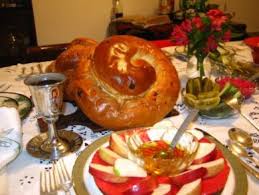
Some things are traditional. There is wine for kiddush. Challah for motzi is usually round. After buying one for many years, they have gotten expensive and are not that hard to make, though sometimes tedious. I made my own last year, better than what I buy. Infusing raisins into the dough has become traditional, and maybe adding some honey to the batter adds to the tradition. Apples covered with honey also starts the meal. Apples have gotten rather expensive the last couple of years. I only need one for this ritual, but the price has deterred my using apples as an ingredient, particularly for apple-walnut pie which I make a few times a year, but it being milchig, it is not suitable for Rosh Hashanah. I have made wonderful pareve apple cakes for dessert, though honey cake, known as lekach, is more traditional, and rather easy to make. Appetizers are a distraction, so I plan to make soup instead. I could use a mix, maybe premade stock with noodles, maybe a bean soup that I start from scratch. Have a few weeks to decide. Making soup is usually straightforward and mostly forgiving of misjudgments of what to put in it. I usually make a salad, often an Israel salad with cubed tomatoes, peppers, and cucumbers but tabouli may be better. I have a mix for this and can add the produce. The entree is still open. A large whole chicken occupies a lot of space in my freezer, obtained free with a discount coupon, I forget if Thanksgiving or Pesach. There are lots of ways to make this but roasted whole usually comes out well. It takes a couple days to defrost. Half turkey breast is another option, usually available in the Empire section of Shop-Rite. And then there is beef but this has become prohibitive in price. I don't think a family Rosh Hashanah meal is the best forum for an expensive brisket. My wife makes a rice kugel each year. And vegetable is traditionally a carrot, known as mirren in Yiddish, which when converted to Hebrew brings a wish for bounty in the new year. Sometimes I make them glazed, sometimes Moroccan with cumin and parsley.
A small adventure to which I look forward each fall.
Subscribe to:
Posts (Atom)