Pages

Showing posts with label University of Delaware. Show all posts

Monday, February 13, 2023

Different Churches


Two in one day.  My wife has taken a liking to choral music, serving as President of one ensemble and a dedicated singer in another.  A rarity, two concerts on the same day, one in mid-afternoon devoted to Spirituals joined by a fabulous children's choir, the other at night in conjunction with the local symphony with a few choral all-stars from a nearby high school added to the singers.  Each took place in a church, though with very different environments and outcomes.

First church very familiar to me.  It sits about midway between the central corporate and financial center of town and the main courthouse, a place of prompt resolution of business disputes which keeps my state in the public eye.  Getting to the church early, driving through a few streets that had a high crime look, though abutted by other impressive church buildings of noble history, I parked in good space, then walked a few blocks through the neighborhood.  There is a main street, once probably a place of valuable real estate, though not for a while.  Were it not for Sunday morning, those blocks would be largely abandoned as are the business and legal neighborhoods on the weekends.  Yet the church itself has maintained the integrity of its exterior and an aged handsomeness to its interior.  The concert took place in its sanctuary, a spacious though not cavernous room with two levels, likely remodeled a few times over its existence.  It's massive pipe organ was relatively new, funded with a massive capital campaign, though the pipes themselves visible from the pews did not sparkle.  Flooring, walls, windows all a little worn, lighting less than the brightness that modern fixtures offer.  Yet a space of heritage more than decline.

It serves a multiethnic neighborhood with people of African ancestry living nearby, and in this age of a robust African-American prosperous representation, some who probably commute from the suburbs.  Those of European ancestry seemed older, probably from the nearer suburbs, though a few still loyal to their church despite having moved to the tonier neighborhoods of the county as their salary increases allowed.  The choir itself has its base in the church but attracts from a broad area, more Caucasian in distribution than the church, even with a few from South Asia, though with the Middle and Far East largely without representation.  And the repertoire that the independent choir adopted reflected the heritage of a church committed to continuing on, adapting as needed to surroundings that were once better.

The night concert took place in a much different setting.  For many years, the regional symphony in proximity to the state university assembled a choir for a joint concert.  They also perform in a church.  Until this year, that church stood on Main Street, a multipurpose building of tasteful brick architecture, small parking lot ample for worshipers, too small for concert attendance.  It's location right on the main thoroughfare of a university town enabled me to transport my wife to the church while I stopped for a pleasant light dinner or a beer.  This year the symphony and choir relocated to a different church just beyond walking distance to the university.  No pubs to stop into. 

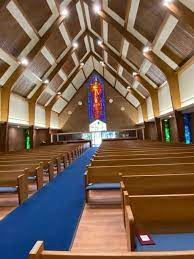
Huge campus though.  Ample parking, several visible wings.  Main sanctuary just inside a small vestibule.  Cavernous space. Plush in every way.  The Presbyterian cross suspended over the stage.  Modern acoustics.  And virtually all Caucasian, audience and performers.  The ad hoc chorus invited choral all-stars from a nearby high school.  Caucasian there too.  And amongst the people who checked folks in.  For a performance imprinted with the state university I would have anticipated greater diversity.  The music was fine, though perhaps a little unsettling that people of color did not seem attracted to perform as instrumental musicians or vocalists, nor attend as people seeking entertainment of that type.  Or maybe that environment.

Leaving the performance, the road home forced us back to the edges of the university.  Neon glitter.  Places to eat, get gas, shop a little farther along the road.  By comparison, the church seemed something of an island seeking separation.  And it succeeded.


Wednesday, May 11, 2022

Inspired, or Not

Two events on the University of Delaware main campus uplifted me far beyond the two $7 parking fees.  I received an invitation to an awards luncheon from their communications division.  For the first time in a while, I mingled, interacted, generated my own ideas, and tapped into the expertise of experts.  Then their Biden Institute, run by the President's sister, sponsored a presentation by Van Jones, most known as CNN personality who accomplished many things by pursuing a perspective different than the one to which I was scripted.  My own FB friends with the protection of distance and delayed response pummeled me for finding merit in groups on their scorn list.  If you only need to find one redeeming feature of an opponent, Van's standard, you will find it easily.  And he did.  When I take that approach, I do to.  So did King David, when he shared his success with Achitophel, who was really something of a dweeb.  He only taught the future king two things, but that was enough for favorable recognition.  And Pirke Avot doesn't even say what those two things were.  Really, in some ways an Omer message, as Rabbi Akiva's students were traditionally decimated for withholding respect.  While on campus, I felt more fully alive.  Not just the two outstanding programs, but also negotiating new experiences, finding my way, exploring some buildings, scenery, and assessing how campuses and generations function differently now. 

So, as I grapple with Languishing, there are some very good alternatives.  They are well within my capacity too.  


Tuesday, July 20, 2021

The Moo Truck


University of Delaware has an agricultural division, which I visited shortly before OLLI went virtual.  The state derives a fair amount of its GDP from agriculture, primarily poultry but as you drive to the southern counties there is also farmland growing assorted vegetables on a commercial scale.  The pride and joy of the University's agricultural division has been its creamery which produces and sells ice cream.  My tour of the facility showed it to be more part of an educational mission than a commercial one.  We watched them make the product using parts of the curriculum from the academic courses and market the product using curriculum from the business courses.  Free sample as part of the tour but there are several fixed sites and a mobile van known as the Moo Truck where the ice cream can be purchased.  

OLLI being a division of the University, the truck comes to the OLLI campus periodically during the school year.  I found the prices exceed what I was willing to pay so never bought any but as a promotion for the return of OLLI to live learning, the Moo Truck will be coming again, this time with cups of unique ice cream courtesy of the University.

They had an event last week with ice cream as a perk to get people to submit their Covid vaccination cards into the University Health System database, a requirement for attending classes live when they resume in the fall.  It did not go well.  So this week, it's just the truck.  I could use some great ice cream and a lot of overdue hellos.

Monday, February 10, 2020

Resuming OLLI


Image result for focus on yourself

It's been a great respite, roughly two months long.  Osher Institute follows a University schedule that affords its students a long winter break intended to pursue independent study or work related to study that really cannot be done in the more typical two week winter hiatuses that most university calendars follow.  As post-career students at Osher Institute we generally do not have that future focus, though I'm sure lots of people headed to the warm or traveled to the exotic or made the grandkids rounds across America, something that requires more than two weeks for optimal benefit.   OLLI is unstructured and so am I.  A lot can be done in two months but my own effort was not sustained.  I submitted a few articles, emptied my storage rental unit, visited my daughter, and made some effort to organize my house which could have happened were my effort sustained.

Tomorrow my classes resume, four + Wednesday afternoon Mah Jongg.  None are really participatory classes this time.  Learn about the eye, perhaps understand why I think contemporary Republicanism is an ethical blight, analyze some historical disasters, and go on a weekly scavenger tour of the University of Delaware.  It gives needed structure to the week, which helps when I try to focus better on the twelve semi-annual objectives that I assemble December and June.  Those things need focus.  OLLI helps me get that.

Monday, December 10, 2018

Back to School

Across the USA there are branches of the Osher Lifelong Learning Institute, acronym OLLI.  University of Delaware has one, which my wife has attended since her retirement.  I've been there for some of their concerts, enthusiastic people, age distribution about what my shul has on shabbos morning.  While my mind was not exactly fallow early into my retirement, having read some books and written some essays, I should challenge it in a more formal way, so I will register for OLLI's coming semester.

The catalog appeared online this week.  I jotted down what interested me, then since each course meets only weekly, I made a time grid and transferred my selections to that.  It was my intent to enroll in three, spread over two days, though I might do four as there are two at different times that stand above the others and I do not want to make a special trip for one.  Applications next.  Some courses are limited in capacity, one requires pre-existing expertise for which I think I qualify, though the instructor may not.  Fill out the applications next week.


Image result for osher lifelong learning institute

Sunday, April 19, 2015

An Afternoon's Optimism


Image result for mineralogical museum delaware

Been under the weather for about a week, bronchitis or some other upper respiratory symptoms, enough to get me to the doctor.  In a recovery mode now.  When I planned my six months in December 2014 I put into the tasks a series of three museum visits in different cities.  I had been to the Landis Museum during the winter and decided to check out the University of Delaware Mineralogical Museum this weekend.  No inclination to attend shabbos services at my home congregation, not enough inclination to return me to Chabad, so I worshiped no place but kept the day as protected time, having breakfast, getting a latte, then a soda.  The museums open at noon so around then I headed off to U of D.

Even though I've been to the University many times, driving through most of it at one time or another and walking the length of Main Street where businesses interface with campus, I've never explored the classroom and residence portions.  It turns out that this weekend, the University set aside the day for accepted students and their parents to visit as they decide where to matriculate.  Parking rules suspended.  Everyone seemed so enthusiastic and helpful.  I parked near the Mineralogical Museum in the Geology Building which itself lied amid a science and engineering complex with the Student Union just a few buildings beyond that.  It was a small but pleasant display, samples of the stuff they tried to teach us with marginal success in 9th Grade NY Regents Earth Science.  Not sure who donated the several significant looking gold nuggets.  No diamwww.chabadde.comonds, rubies or sapphires, some relatively crude emeralds but mostly the stuff that constitutes the middle segments of Moh's hardness scale, yet specimens of natural beauty and crystal formation.

This did not take very long.  UD has three museums, one a photography exhibit on pre-civil rights African American experience and achievement, the other at the original College Hall a small painting and drawing exhibit, both small, both manned by very pleasant students who could answer a few questions about the display and seemed genuinely pleased that a visitor took enough interest to ask about it.

To get from the science complex to the building where I assume the deans hang out I had to traverse a good part of the campus, the college green hidden from traffic but with abundantly filled bicycle racks, a few students lolling on the green with a book, aware that finals could not be far off.  There were activities announced on bulletin boards, visiting prospective students on guided tours, scatting young ladies with blue Ask Me t-shirts.   It's a place where you can immerse yourself in the world's future, if only for about two hours.

But I did not take a comparable amount of time to worship that shabbos morning.  I don't know if any of the kids on campus did either.  What I can say, though, is that the future that I wandered through at the University would not be duplicated any shabbos morning at my synagogue or even Chabad.  Eventually these kids will have to fill in schedules and meet deadlines just like they do at my synagogue but doing these things is part of the process of their advancement.  For us, whether at shul or at work, filling the schedule has become the end point, devoid of any future growth.  At UD the museums reflect a small element of memory or knowledge.  Work at the hospital where residents expand their skills while patients recover also reflects a future.  Shul though, even on shabbos morning, is the museum.  People seem to have lost the ability to tell the difference.  Optimism seems much more limited in that environment.  But as long as optimism exists elsewhere, it can be captured elsewhere, as I experienced yesterday.

Monday, February 24, 2014

Jewish Young Adults in Attendance

Not that many youngsters attend shul or any other AKSE activity other than Hebrew School, and there aren't all that many of them either.  In my day we had a full Junior Congregation linked to Hebrew School along with evening childhood activities like weekly dance lessons.  Post Bar Mitzvah, there was a very tenuous Hebrew High School program, what would be called Confirmation Class nowadays but social activities for the teenagers continued in a big way, from USY which was really more of a basketball night and weekly bowling league which met at the synagogue after school for transport.  As a consequence of this we maintained acquaintances with each other to about our second year of college, when final dispersal took place only to reconnect some forty years later as Facebook Friends.  About half of my FB Friends had a link to the JCC of Spring Valley and some maintain synagogue ties now, though most have been part of the larger attrition from Conservative institutions.

So where might today's Jewish youth be?  I suspect they are blended in with everyone else, though probably still extractable with a social parallel to the lab sep funnel.  Last evening after shabbos I attended a concert which brought me to the U of Delaware campus.  Since I got there early and wanted to keep a commitment to myself of trying out two unfamiliar beers each month, I wandered along the town's Main Street checking out ice cream places and pubs that might have a craft brew that I could down in about a half hour before the concert.  There was a place nearby but no room at the bar and the gelato line moved too slowly so I departed.  Further down the street was a sports bar with all sorts of offerings though none truly new to me that would satisfy my project.  While the first place had some sophistication, and probably expense, to attract professors or others who already had steady incomes, this second place had students occupying nearly all of its floor space, most with a beer in hand, some alcohol already soaking their white matter, and no doubt some phony ID's in their wallets.  As I wandered in, some of the kids picked up on my trimmed gray beard, bolo tie and crotcheted kippah.  Many were actually rather solicitous of me or at least curious as to why I was in their neighborhood.  As I departed back to the street, others also picked up on the kippah, approached me to demonstrate how little they learned in Hebrew School but were rather friendly and most important they were present and identifiable amid a very large population of students and able to seek me out without my approaching them first.

The following day I needed to see some patients, a project less difficult than anticipated, so I used the extra time to detour my customary route home to stop at IKEA.  Sunday afternoon attracts a lot of shoppers of a very diverse range of ages and other elements of appearance.  Many young families present, numerous ethnicities with a variety of conversational languages going on around me as people looked at sample kitchens, shelving, and any other furniture item that can be configured into a flat box for transport home.  While I did not hear any Hebrew or see any kippot, the volume of young families seemed staggering.  If the people we hoped would enhance our diversity at AKSE were not to be found at shul, they were very likely to be wandering the floors of IKEA instead.

There is a certain entropy to Jewish life, at least locally.  Kids at the U of Delaware could see my kippah and greet me in the broken Hebrew that they retain as a residual from Hebrew School but at least they recognized it and have some polite attachment to it.  The people at IKEA are enhancing their home lives in some way by shopping there.  U of D gatherings were a public expression of community, IKEA a more private array of personal aspirations taking shape in a public forum.  If that's where these people are then the honcho's of the declining Jewish institutions will have to infiltrate their turf to capture their interest.  No amount of programming will bring these people to AKSE, not even with a keg of beer and no ID checker.  The people places like AKSE or Federation might like to entice will not be at the university for very long but they will be at places like IKEA creating their homes indefinitely.  They will need to choose from innumerable options but whatever they take home then has to be assembled to become usable.  We need to think a little more like them than like us if we really desire to have them include established organizations of Jewish interest among their destinations.