Pages

Showing posts with label AKSE. Show all posts

Sunday, January 11, 2026

That's Who We Are


Often I attend Shabbos morning services out of a sense of obligation.  It is not unusual for people of my era.  The Protestants and possibly the Catholics share this legacy.  Synagogue or Church is the place you go on your weekend morning.  Blue laws existed to my young adulthood.  Stores remained closed, though Kosher butchers and Jewish stores in the states where I lived could choose to remain closed on Saturday in lieu of Sunday.  There were places to get breakfast on Sunday, coffee shops, bakeries.  Some eating places, though, did not open until after noon when church let out.  Recreational facilities opened at noon.  Place of worship served as a default.  Sunday served as a communal time out, at least for the morning.  The NFL still played in the afternoon.

Fractures began in my university years of the 1970s.  Shabbos services were readily available wherever I lived.  Social pressure to attend in a population that had escaped parental mandates disappeared.  Still, regular student worshipers kept services adequately attended.  Thirty years later, in my children's student years, I had occasion to attend their Hillel.  People of their generation still filled two small sanctuaries, one Orthodox, the other Conservative, each time I visited, combining themselves to partake of Kiddush when both services had concluded.  Still, the attendance represents a small subset of the University's Jewish students.  

My own congregation, where I have maintained membership for 28 years, did fairly well, adding my generation to the one that preceded us.  Young families entered at early career, raising children, staying indefinitely.  The generation ahead of mine also had children, though few settled in the community.  Perhaps we had elements of a Jewish Ponzi scheme where new players from the outside had to replace those who cashed out for Florida or relocated to be near their own kids or became actuarial statistics.  Still, that system functioned.  It no longer does.

How can we restore ourselves to multi-generational, if not intergenerational?  For the last year, our Board and Membership Committee, with the Rabbi's professional and self-interest, embarked on a membership enhancement effort.  And newcomers have added themselves to our rolls.  You can only improve what you can measure, something that our people avoid doing in any depth.  Coming to services out of perceived obligation yesterday, I sat up front, first row, taking the required two books along with a plastic bin to stash them and my tallis bag under my seat.  The choreography of the Saturday morning services forces me to gaze from my seat at the very front to the back wall periodically.  I did this enough times to survey who came.  It seemed much like other Saturday mornings.  One person I did not recognize, another the son of the man being honored at the remote anniversary of his Bar Mitzvah.  Everyone else I could name.  Our two sets of fathers of young children, who each attend as half-couples with much less frequency than they once did, did not join us yesterday.

Total attendance, about thirty individuals, more men than women, but not our most lop-sided attendance.  Often, I count half-couples and full couples.  Yesterday I did not, but no unusual drift from our usual pattern.  How many under age 70?  I didn't know who among us had reached their threescore and ten.  How many under 60?  That I could make a reasonable estimate.  The Rabbi, son of man being honored, and likely the one person I did not know who drove into the parking lot at the same time as me, took a seat in the last row, and left before the service ended.  So three for sure.  And three other could be's.  A doctor who comes about half the time, a fellow who participates regularly, and a new person who comes with increasing frequency, whom I've met a few times.  So of thirty people, that leaves us at between 10 and 20%, with two of the for-sures being transient.  Our internet allows us to retrieve publicly available information quickly, including people's ages if you know a few other things about them.  The doctor and the regular participant go into the over 70 slot.  The other woman is likely a contemporary of mine, likely past 60.  So of the people in frequent attendance, the Rabbi is junior to the next youngest by at least ten years.  I checked some new members not present.  A couple in their 60s.  Another doctor in her 70s.  And another doctor in his early 70s with his wife in her 60's.  And one real young adult, the grand-daughter and daughter of members traceable to the World War II era.  I've not seen her at worship.

My own activities put me on a second tier.  Bimah skills get me invited to the sanctuary's center table with some frequency.  I attend Board Meetings as a member.  I attend the meetings of one committee.  I'm probably also their most inquisitive observer.  Wanting to keep our synagogue from actuarial collapse seems a laudable initiative.  Trying to do this without exploring how others succeeded, or failed, without tapping into those with expertise or experience on a project this important seems a form of folly.  And should this be our goal, especially one that has not explored a system to do it?  

A young woman I had a chance to interview suggested an answer.  To enhance membership, the Rabbi and High Holy Day Committee designed an experiment.  We would offer a sweetheart deal to attend our High Holy Day worship, one in which our synagogue invested heavily.  For a nominal sum, about 4% of dues, people not affiliated elsewhere could join us.  Only two takers.  One, a couple in their 60s, already contemplated joining and did soon after.  The third person came primarily wanting a place to worship without commitment, a woman who had her Bat Mitzvah with us when we had a more robust collection of families who still had children in their houses.  I interviewed her afterwards in my capacity of Membership Committee member.  This poised rising thirty-something, a product of our congregation, very familiar with us, assessed her experience at the Holy Days.  My position required me to discuss membership, knowing that her past experience had many downsides.  Rather than telling me she did not want to risk reliving any of that, she responded differently.  She told me her impression.  Our congregation was not a place that young adult Jews would seek out as a path to their growth.  It is not who we are.  We are a Medicare Club, seeking new people to protect our financial future and the Rabbi's professional future.  That is our goal.  Advancing a new generation to take the place of a declining one serves as a byproduct, if it happens at all, not our incentive for the membership enhancement that we seek.  We might do better by accepting what we are.

I do not know which is the better path.  For now, looking around, counting our successes, we've not done badly as a place where Jews in their later years come together.  Worship, governance, events, even the rhythms of congregational life.  What we are has emerged as our default.  The challenge may not be in recruiting a new generation but in giving those with us the most fulfilling experience we can offer until the generational reality expresses itself.  

Sunday, June 22, 2025

Annual Meeting


Mid-June on a Tuesday evening every June.  My synagogue's by-laws, which a handful of people have read once, requires the congregation to meet at least once a year.  Pre-pandemic the assembly took place in person.  Once electronic interface became available a Zoom option was added.   After perhaps one or two Junes, the in-person option was suspended.  I don't remember.  But this year we met hybrid, with approximately equal attendance between our sanctuary and the parallel screen. I much prefer being on site with other people who I might poke in the ribs as speakers express ideas that could have been reasoned better.  Those always seem plentiful.

The evening's agenda has two mandated items.  Our members must formally approve a slate of officers and the coming year's budget by a majority vote, which usually approaches a unanimous vote.  A Nominating Committee recycles the VPs each year since a by-laws amendment eliminated term limits for all officers but the President.  Some have twelve years experience.  Some have two years experience repeated six times.  No new individuals added, though minor shuffling of titles.  The budget has become predictable.  Figures presented, trends noted.  As our membership and dues base declined over maybe twenty years, we live off our accumulated wealth much as the seniors who comprise nearly all our membership do.  Mostly an evening for the people who occupy many committees to tell the people either not on committees or blackballed from them how wonderful the past year's experience has been for them and therefore should have been for us.  Not all of us agree, and each year there are about five fewer of us.

It starts with a welcome from the President, who has led diligently for his three years.  The Rabbi offers some words of Scripture and Talmud.  Then a list of activities that he did in his official capacity.  Then the President speaks.  Then we vote on budget and Board Members.   For an organization that declines a little each year since I arrived there in 1997, a defector from someplace else, it would have been better to have the VPs each issue a page of what happened under their watch, attach these statements to the email notice of the meeting, and adjourn for pareve cookies. Instead, we heard recycled projects.  A list of Torah and Haftarah readers.  We have quite a few.  A list of people who performed one or more aliyot or haftarot for the first time would have abbreviated that list considerably.  I would still be on it.  Education Committee.  Ample projects.  None created by the VP, who still thinks people will flock to signup sheets.  Some things do much better when you invite people.  A High Holy Day committee.  This is rather complex, but it hasn't changed in either format or participants other than our Rabbi's relative newness.  We still have designated women's chairs with signs on them usurped by our all-male choir during their break.  

I like numbers.  Seeing them.  Toying with patterns.  Playing with them.  Imagining how they might be different.  What I saw were committees with names of people attached.  Mostly the same people on every committee.  One VP had the temerity to tell everyone not on them to step to the plate and get on them.  First guy I poked in the ribs, having been blocked from two that interested me by the Dominant Influencers who really don't want smart inquisitive types challenging their agenda or process.  They don't need or want no help.  One of the roles of titled people, one by which folks in my medical world are judged, is the ability to seek out people who can bring knowledge and insight to make each committee more effective.  Two Committees have done that, Security and arguably Ritual, with the Rabbi infusing it with imagination and technical knowledge.  The rest of what I witnessed registers as Group Think, that invitation to nod last year's activity with nary a what if we did this instead.  Nobody challenges anything.  Ways & Means, External Communications:  No committee, just honcho delegating, and often less than that.

They expressed a desire to reverse our annual membership decline.  You do that best by engaging the people you already have.  I think I would ask every chairman who they sought out in the last two years to make their portion of our Congregational programming more effective.  It's mostly none. Make them each seek out and invite two. Then have the Rabbi and Membership VP get a list of every man, woman, and child, putting a checkmark next to each committee or organization each contributes to.  Some will have so many that they should be asked to choose which ones they want.  More will have too few.  They were never invited, and a few shooed away.  Invite them.  And then give the VP who chastised those with too few checks next to their name another deserved poke in the ribs to broaden his understanding.  

Wednesday, June 4, 2025

Other Congregations


Busy week of places of worship, alternatives to mine.

  1. My shul, Saturday Morning, worship
  2. Episcopal Church, urban area that has seen better days, Saturday evening, concert
  3. My former synagogue, part of city where few Jews live, Sunday afternoon, guest lecturer
  4. Traditional Congregation in posh area of distant city, historical legacy, Saturday morning, worship
  5. Presbyterian Church, distant city, middle-class suburban, Saturday afternoon, reception
All different, mostly different purposes.  Some familiar to me, others part of my more distant travels.  Some eagerly awaited attendance, others more grudging, purpose-driven attendance.  Using my familiar synagogue as the anchor, the other four sites, with my experiences there, expose what might be possible.  And some of our practices, particular to us, have their own superiorities not always appreciated until placed next to an active alternative.

Given a yellow pad with erasable pencil and assigned to create a synagogue teeming with my druthers, not subject to vetoes of clergy or Dominant Influencers, or even majority votes, my final product would have some features of mine, perhaps less focused on a legacy once more glorious than current circumstances. Each of the other four brings something to that yellow pad.

The Episcopal church has an active music program.  They hire a full-time music director.  Many Christian churches depend on music to engage people, to create a spirit.  It sometimes comes at a price when those in attendance sway to the music but never acquire significant literacy with either of their Testaments.  Still, the music there has elegance that we cannot hope to duplicate, or even want to duplicate.  Generous donors enabled restoration of my state's largest pipe organ.  They named it in memory of the sweetest pediatrician, a church member who became a dominant presence in our local medical world when women of that professional stature were scarce.  Organ specialists from Warrensburg MO, halfway across America, came to guide the organ's assembly and its majestic sound.  The music director auditions participants to ensure that musical skill exceeds a threshold.  The concert that I attended attracted musicians from the community as well as the church.  Difficult music in more than one language.  A detailed program with some advertising, solicitation of donors, and expert bios of key performers.  An amateur musical historian outlined each piece and its composer.

This church sits at the edge of a neglected part of town, a few blocks walk from a dangerous neighborhood.  Like my synagogue, it is a merger of churches from times past.  Its building is worn, parking adequate for the occasion, though people still need to find space on nearby streets.  They hosted a reception after the concert.  I had made 48 oatmeal chocolate chip cookies as a contribution, while others provided a mixture of sweet and savory handhelds.  The congregation has a recognizable political element, as the Palestinian flag that greeted committed Zionist me when I checked in caught my immediate attention.  At each concert, the chorale provides a feedback sheet to assess who attends demographically, motivations to attend, and other comments.  My own remark about expanding beyond European/American choral music was taken seriously, with this concert including a popular Israeli song.  It toned down that flag, but I still questioned its propriety in my comments.

What might I import?  We have a volunteer choir, restricted to males.  At one time, we supported a mixed choir that performed as entertainment once a year, never as liturgy, but very much part of my shul's signature events.  We do not take feedback seriously, a reality of a culture with a few Dominant Influencers who I think really believe any practices not their own are inferior.  For religious dietary restrictions, we cannot have random people bringing potluck food.  We sort of have a political stance centered around Zionism and support of a modern nation state with unchallenged Jewish sovereignty.  Within that framework, though, we have much diversity.  We also have former members who have made Aliyah to Israel We also have children of current and former members living there and subject to the Israel Defense Forces universal draft. While none have been reported a casualties, we are aware of the realities.  Some members are rather cavalier supporting an aggressive offense as the most effective defense.  Others are more acculturated to making win-win deals, limited primarily by a suitable partner.  Some members are MAGA and ZOA, more are registered Democrats who wince a bit at anti-Semitism from the left.  Many of our members have degrees from those elite campuses where the taboo on anti-Semitism has been lifted.  But as a congregation, we are neither Red nor Blue.  In Jewish tradition, we fall more toward analysis of the possibilities.  But the Israeli flag remains in a secure position at the front of our sanctuary and at all off-site events that we sponsor.

Often the harshest comments fall on the organizations that one has defected for cause.  Places that nominally share your heritage, sense of tribe, your manner of thinking, yet have a leadership on site and enthroned centrally that betray core personal aspirations.  The shul where I attended the lecture reflects that mixture of admiration for some things, but enough repulsion to others to relocate my synagogue affiliation after seventeen years there, with some visible positions along the way.  While Rabbis have come and gone, most personable, the macher-dominated influencers of old have been cloned as proteges.  I go there for worship maybe once a year, less now that they put bouncers at their front door to gatekeep those not registered with their office in advance.  After my congregation sold its building, they housed us there.  Their chapel was fine for worship, the people I encountered most weeks were cordial.  They have more money than we do, helped out by a few members of serious wealth.  And if we needed a tenth man, they never hesitated to provide one.  While not mistreated, we were clearly tenants.  It took no time for our officers and Rabbi to realize that we preferred finding our own place over renewing our lease.

Yet as I walked around the interior, I could see that they had useful undertakings. When people walk into their entryway, where our Kiddush would be held, they could see alphabetized boxes of name tags with lanyards.  They felt it important that their people, whether regular or sporadic, prominent or obscure, have people address them by name.  At the entry door stands a big flat screen displaying the Shabbos program and upcoming events.  At one time, our congregations were of comparable size.  Over decades, each has contracted, ours far more than theirs.  They have a spectrum of ages, including children and families in their prime years.  As a result, they have organized subdivisions with social activities as well as learning initiatives. Multigenerational without really being intergenerational. They lack members with the level of observance and liturgical skills that we have, but they are an educated collection of people who understand Jewish history and culture, as well as people who engage with the community's less fortunate on a much larger scale than our members do.  Yet the sting of the mistreatment of people very dear to me has remained in the background, nominally forgiven but indelible in its own way.

I go there for events.  This time a big one.  While we think of Orthodox congregations like mine as defenders of formality, the Conservatives have their institutional norms and tiered agencies as well.  New Rabbis for the past thirty years or so undergo an Installation.  This occurs over a weekend, with a committee of important people designing a program.  Elements of solemnity, elements announcing importance not only of the new Rabbi but of dignitaries from elected officials to people of public recognition in the national Jewish scene.  Their committee invited one of America's premier contemporary Jewish scholars.  I listen to his podcasts or TV interviews with some frequency.  While I'd be willing to pay to hear his presentation, this time the committee offered the chance for free.  It turns out, when the new Rabbi, the son of an interfaith marriage, made his first advance to a career as a Jewish professional, the guest speaker, also a man of obscurity but immense potential, guided the not yet Rabbi for a summer.  Over time, both succeeded grandly.  His mentor came to the synagogue for a Sunday afternoon.  

Only two people from my synagogue attended.  The attendance from the host congregation seemed an older cross-section of their composite.  The Installation Committee made sure sweets and drinks in abundance sat on tables at the perimeter of their auditorium while people sat at tables facing the stage.  I greeted the people I know, but as I usually do at gatherings of this type, opted for a table with people I did not know.  The presentation did not disappoint.  A man of great insight.  Following brief remarks, the guest and the new Rabbi engaged in a Q&A with each other.  Time for questions was not allotted, but I could not let this opportunity go by without asking the scholar about something I had heard from him on one of his podcasts.  Only three people of an attendance of about a hundred approached him.  He answered my query in the expected thoughtful way.  I got some layer cake, ate it quickly, drank nothing, and then headed home.  A fully satisfying afternoon.

By week's end, I flew to another part of America for a family event.  I once lived there fifty years back.  My son lived there much more recently, married a young woman whose family lived there, thus the location of this event.  While there as a student, Hillel was my Jewish anchor.  The students had a loose connection to an Orthodox synagogue nearby, which I visited a few times with other students.  The Hillel Rabbi became a friend, particularly after he accepted another directorship not far from me.  I invited him to my congregation as guest speaker shortly before his tragic passing in a freak accident.  I never attended any other mainstream synagogue other than Friday night service at a Reform congregation near my hotel when I returned to the city for a conference.  

One synagogue of interest, maybe the only one of interest, passed me by.  I never worshipped there as a student, yet knew of its pioneering presence.  On return visits, a few over the decades, I never had both a Saturday morning off and a car to get there.  This congregation still exists in a form very similar to my home shul.  In the mid-1960s, many of the social restrictions placed on American Jews by the Christian majority's upprer crust had broken down.  We often had premier educations, making us attractive to employers and the professions.  Restrictive covenants on houses either disappeared or became legally unenforceable.  Many Jews acquired prosperity and professional stature starting a few decades before, but becoming more commonplace.  Jews in that city lived in a particular enclave not far from the dominant university.  As businesses expanded westward, followed by luxury housing, a Jewish professional community established itself.  While all but a few could have commuted to the established congregations, at that time clustered near the university, enough wanted their own location, one that would hybrid Orthodox and observant Conservative traditions.  They opted for independence from an umbrella organization.  

The congregation thrived over the years.  More of the Jewish population moved westward, as did some of the established affiliated synagogues.  The new congregation invested in its own campus.  While Jewish demographics changed, so did accepted practices among those suburbanites.  Jewish neighborhood enclaves became harder to define.  Most importantly, the role of women in worship and congregational governance became the norm for most congregations with secular membership.  This congregation did not follow that trend.  While offering worshipers the option of gender separate or mixed seating, as my Hillel of that city did, and my home congregation did until very recently, the role of participation of women during formal services remained limited.  Over time, women were offered a few honors like reading the few English passages that congregations use in their liturgy, but leading worship remained a male obligation and a male fulfillment.

This visit, the event that brought me to town, would begin at 1PM, located just minutes from the congregation I always wanted to visit but never did.  The waning of anti-Semitism as a public taboo has changed synagogues dramatically.  All American synagogues now have limited entrance with a professional security guard, usually with pistol in holster, at the only designated entrance, which is locked.  I anticipated this.  Before my visit, I sent an email to the office, introducing myself and my reason for wanting to attend.  They accepted this, notified the gatekeeper that I would be coming, and had my name on a small scrap of paper in the police officer's possession when I arrived.  The rabbi and his wife quickly recognized the only person sitting among them unfamiliar to them.

Staying the course on worship format comes at a price.  Women the years I lived in that city did not have a role in conducting services.  Moreover, their presence in medical school, STEM, law school, and MBA programs was a pittance of what women subsequently achieved.  If accepted in education and professions, not having parity in synagogue generated  resentment.  Women largely gravitated to congregations that would function in parallel with the gender parity they experienced in their professional lives, with places like mine and the shul I visited contracting in membership and attendance.  

My Waze route from the hotel to synagogue directed me through a very tony part of the area.  Developments with McMansions spoked from the main road, a few with gates.  The congregation had created a stunning campus.  Upper and lower parking areas.  Parsonage for the Rabbi, who I suspect could not afford a McMansion of that type within walking distance of the sanctuary.  I parked my rental, then took my time walking a significant upslope to the main entrance.  The officer recognized me as a designated visitor, greeted me, as did the maintenance lady on duty that morning.  They had a weekly bulletin, far less informative than the one the volunteers of my congregation create each week.  I looked at the donation plaques in the lobby.  That tells a lot about the membership.  Some donations have inscriptions less than three years old, including some honoring a Bar Mitzvah.  I do not know if they have a Hebrew School, but wall hangings suggested they might.  

Two congregants in the lobby introduced themselves.  They directed me to Siddur and Chumash on shelves in the lobby.  They use primarily the Koren Siddur and Artscroll Chumash, but had other options and included page numbers from three different books for the week's Torah reading.  At the entrance to the sanctuary, I asked if men and women sat together or separately.  He indicated both options.  I took a seat in the center, one of the mixed areas, though a significant number of men and women, including the Rabbi and Rebbetzin, placed themselves in the gender specific section.

My arrival coincided with my typical entry at my congregation, late in Shacharit, a few minutes before the Torah Service.  A gentleman approached me, asking if I were a Kohen.  I am not.  The service took a choreography very similar to my home congregation.  Three men divided the Torah reading, one being the Rabbi.  They had the same portions led by women that we do, some English readings blessing the Military and Government.  It is customary to offer an Aliyah to visitors, so I received one.  The Rabbi gave his sermon of about twenty minutes, a few references to the weekly Torah Portion, more time devoted to his perspective on the disappearing taboos on anti-Semitism on our campuses and elsewhere in America.  Some parts of our service were shifted to other times, making the closing prayers a little shorter.  They had an interesting addition, asking people who would be traveling in the coming week, which included me, to identify where they would be going.  I planned my return home.  Another fellow had a business trip to China.

After the service, refreshments are customary.  It gave me a chance to trade notes, to get the comparisons clearer in my mind without expressing them.  Their rabbi knew my former rabbi and had served as a reference to candidates for his replacement.  I do not know the financial trajectory of this synagogue.  They have an exquisite campus, unlikely to be funded by annual dues.  Their current membership approximated ours.  I did not ascertain their peak membership or when it occurred, but mixed seating/ male exclusivity, which had been a Conservative Jewish norm at their founding, as were certain hybrid congregations, had fallen into public disfavor.  The members who remained seemed older, maybe a few years younger than ours, and attended weekly worship in larger percentages than the more secular membership of United Synagogue and Union of Reform Judaism congregations.  They have many more dues payers, but sanctuary attendance comparable to the place I visited and my home synagogue.  Since I had the event that brought me to the area approaching, I wished people a Goot Shabbos, thanked them for their hospitality, and then headed back to my hotel to retrieve my wife.

That event, located just a few miles from my hotel and the synagogue, brought me to a Presbyterian Church named after one of its saints.  It stood in a neighborhood of much more modest residences than the synagogue.  It had an impressive building, reasonably spacious grounds, but not the campus feel of the shul where I had just observed Shabbos.  A handsome building dominating a small hill.  Their entry foyer highlighted a few activities, the type that discloses what the congregation values.  They sponsor outreach to the less fortunate, whether by economic circumstances,  isolated by age or infirmity, or members of marginalized groups.  References to youth programming appeared.  We entered a multipurpose space where our event would occur.  It had multiple round tables occupying the bulk of the floor surface, yet with enough perimeter to allow some cushioned seating and adequate greeting of others sharing this event.  Their sanctuary was locked on this Saturday afternoon.  Its entrance had tinted windows which allowed a view inside.  A stage of ample size offered a lecturn for the pastor, floor space for choir or musical presentations integral to much Christian worship, fixed wooden pews encircling that stage, and traditional motifs of Christianity, if not Presbyterianism, on the back wall of the stage.  The sanctuary would seat hundreds.  

The building served multiple purposes.  I wandered into their kitchen, probably a secondary focus of what their congregation does.  Large space, modern commercial appliances and work benches.  To get there, I had to pass other rooms, likely educational or meeting spaces.  I did not encounter their administrative of pastors' offices.  It seemed a multigenerational congregation.  How well it functioned as an intergenerational worship institution I do not know.  There are things a visitor can ascertain from the surroundings, other vital elements of a worship community known only to the regular participants.  

In this age of modern websites, something virtually all American congregations have created, it is possible to learn more about each congregation beyond the impressions of personal visits.  Many present their monthly or quarterly bulletins on their site, with a list of events and activities.  The ability to assemble these without fail, weekly for my synagogue, monthly or quarterly for others, and to have members who load what the writers and editors create onto their public electronic forums is a notable achievement.  It goes on as daily work, much like the clergyman's weekly sermon or religious school curriculum.  Under the radar to outsiders, even many insiders.  My journey across five congregations in a single week brought a blend of what makes each unique, but also what creates common ground and what remains hidden to the intermittent observer.  Some seem more insular, others more insistent that their sanctuary doors swing outward, figuratively if not literally.  Some value left-brain didactic learning, others more focused on right-brain aesthetics.  They differ a bit in the spaces allotted to gathering, whether size of sanctuaries or public spaces.  In order for any to function, they each require small dedicated groups to allow dedication to priorities and critical masses to execute and participate.

As I visit four others plus my own, my mind gravitates to the familiar.  My synagogue does a few things very well.  The places I visited each have their own strengths, some of which we could tap into to enhance the things we offer.  There is also an inertia, most visible among the most familiar, as in mine.  An Elsewhere performing better is not always envisioned as something to seriously consider.  The unfamiliar, even when an upgrade, threatens something or some people's dominant influence.  I saw elements of imagination, particularly from the distinguished Jewish visiting scholar.  I encountered tenacity in preserving core practices, perhaps lamenting decline, but accepting it as the cost of traditions that cannot be diminished.  There are places for scholars of national stature, elegant worship campuses, sophisticated music, and external outreach to reinforce a mission of kindness.  These all exist in the places I visited, but not all in each place.  Design my ideal synagogue with a pencil on a yellow pad?  As much as I might want to include pieces of what I experienced, that's not the best option.  Adam Smith of Wealth of Nations had a better idea.  Accept the diversity.  Contribute what your place of worship does best, then share those things with everyone else for mutual benefit.  That best captures my week at different congregations.


Wednesday, April 2, 2025

Shabbat Pageant


Too much.  Over the top.  My personal connection to Friday night services, known as Kabbalat Shabbat, has cycled considerably over a lifetime.  As a youngster, primarily 1960s, we belonged to a United Synagogue Affiliate, a member of the Conservative Movement.  While the suburban Reform congregations showcased Friday night as the demarcation between the commuting work week and respite, the Conservative synagogues held their traditional services on Saturday mornings.  Friday nights became special events, attended more for the specific event than the sanctity of Shabbat.  My congregation, now defunct, had programming that would violate many of the Shabbat restrictions.  We held Bat Mitzvahs on Friday nights.  A choir would perform liturgical melodies with organ accompaniment once a month.  Programming included guest speakers of community prominence of panels of members doing presentations from campers showing the dances they learned to honoring the graduating High School Class to hearing what a local Civil Rights leader had to say about recent initiatives or legislation.  The services were timed for 8PM, competing with That Was the Week That Was and The Flintstones in the pre VCR era.  My family essentially only went to announced events.  The evening served as much a communal as a worship function, starting late enough so that men could drive home after a long week in the trenches, eat a more elegant dinner than other days, and still get to services.

My two years as a camper, Friday night served a different purpose.  Our parents were told to pack white outfits:  shirt, long white duck pants, while suede oxfords, to be worn on Friday nights.  We assembled for services, rather late due to Daylight Savings Time, then a meal in the communal dining room with singing before Grace after Meals.  Finally we assembled to a public space for Israeli Dancing, with most campers getting the gist of the steps before the summer ended.

College brought a variant of that in a way, recognizing that Friday night was traditionally university date night.  The classes ended, exams over.  Shower, put on a clean shirt and sports coat, services timed to candle lighting, but always quick and efficient.  Then to dinner with chicken soup and roast chicken.  The dining room always attracted a lot more people than the sanctuary, but services remained similarly attended on Friday nights as they did on Saturday mornings.  Commencement done.  Friday nights generally history for me.  Saturday morning became the anchor of communal Shabbos with Friday night reserved for unwinding, some weekends taking medical call, and a meal with kiddush and motzi.  Friday at home, Saturday at synagogue.  However, at our Conservative synagogue, services still began at 8PM where they remained for decades.  Eventually, the Conservative Rabbis, noting marginal attendance, opted to move Kabbalat Shabbat to a pre-dinner hour to enable them and maybe some congregants to have more of an uninterrupted home Shabbos experience. Rabbis sang songs or hosted dinner guests.  Congregants watched Dallas and Wall Street Week.  The Reform Movement kept Friday night as its centerpiece, including periodic programming.

This turned out very useful for me the year I needed to recite Kaddish for my father.  I had taken a new job that required a substatiantial commute.  By the time I returned home on Fridays, the week and driving had taken its toll.  Most of the year Shabbos had already begun.  Chicken got seared and baked before I left in the morning.  My wife finished the meal preparations and lit candles before I returned home.  Then dinner, then Kaddish.  My only realistic option was our local Reform synagogue.  Despite the sad reason for attendance I liked going there, not missing TV at all.

The Reform Movement had issued a new prayer book shortly before.  It offered their rabbis considerable flexibility of content from week to week.  While this congregation had a much different format from my traditional one, the choreography of the service remained fully recognizable.  An usher with name tag handed out a program as people entered the sanctuary. I selected a seat towards the back half, a place that I sought out most times.  They had an organist accompanying their cantor, both people of musical talent.  Periodically their choir participated, but usually not.  A woman lit the candles, irrespective of whether Shabbos had already begun on the clock.  This honor went to a board member or a Bat Mitvah girl, one of their few retentions of gender roles.  Then the service, a mixture of readings and familiar tunes.  Most weeks their Rabbi delivered a message, though sometimes a guest spoke.  Towards the conclusion, children under age 13 came to the Bimah where the cantor chanted Kiddush and the Rabbi blessed the children.  Ill acquaintances blessed, the departed memorialized, and the service concluded with their organist playing the tune to a hymn that varied between weeks while the congregants sang.  Then everyone assembled in an adjacent room for snacks.  It had predictability despite the variances in weekly content that added interest.  Even on special Shabbos weekends, whether partnerships with African American congregations for Martin Luther King Weekend or an invited guest of special accomplishment, the format avoided elements of public spectacle.  After my year of Kaddish, the fondness for the experience remained, so that I continued to attend periodically.  Eventually their Rabbi or their Board opted to move the time from 8PM to 7PM.  That largely ended my Friday nights there, and the few times I ventured out, their attendance seemed at least a third less than it had been.  The format remained unchanged.

My Traditional congregation has Friday night services timed to pre-dinner. Getting there and back, approximately 20 minutes in the car each way, puts my attendance in competition with Shabbos dinner.  I opt to have a pleasant meal with my wife.  I do not know if they assemble the required ten men each week.

And then we have events, times designated to venture beyond the ordinary, yet stay in bounds with fundamental purposes.  My congregation sponsored one of these, a multipronged extravaganza designed to tie different elements of the larger Jewish community, celebrate a milestone anniversary year for our synagogue, and perhaps right some wrongs that left us as victims.  

It had been a tradition for many years that our umbrella agency, The Jewish Federation, would designate one Friday night each year for one synagogue in our county to host the others.  Population migration has brought a significant number of Jews outside the reasonable driving distance, but pandemic normalized Zoom has enabled electronic access.  This is acceptable to all congregations but mine and Chabad, where electronic prohibitions on Shabbos are maintained.  Moreover, Chabad officials do not drive and their sanctuary is too small for a communal event so they have not participated in these geographicallly expanded Shabbatot.  Moreover, our clergy do not drive or ride in motor vehicles on Shabbos so their participation has been limited to our host years, though our officers have been full participants.  While liturgy, acceptance of women, and Shabbos restrictions vary among the county's synagogues, it has been the custom that each host showcases itself.  If only the Reform affiliate allows an organ, all congregations and their clergy accept that under the banner of Achdoos, or communal unity.  Experiencing each other in their own way serves as the foundation of this annual program.

Congregational fortunes have their own life cycles from creation to closure.  Mine started 140 years ago, the incentive for celebration.  In that time it has experienced internal history from locations, mergers, membership growth, programming adapting to the expectations of different decades.  In a much more compressed time, maybe my 70 year lifetime, organizational Judaism has experienced attrition.  My Bar Mitzvah synagogue, class of '64, building cornerstone '54, closed in '06.  My dear congregation as a newlywed, where I only worshipped for one year, swooned from 400 members to 29 over about 25 years.  They had a benefactor.  Like my Bar Mitzvah congregation, they ran out of people before they ran out of money.  My congregation faced a similar trajectory.  Declining and aging members without replacement.  No tycoons created in the 140 years of our existence.  We opted to sell our building which will keep us financially solvent until the actuarial realities catch up with us or an unanticipated influx of younger members find our traditional ways sufficiently attractive to pay annual dues.  With diligence and an interim location, we rented more suitable digs to call our own.  Weekly attendance of about forty makes our sanctuary appear reasonably full.  Accommodating hundreds, a possibility in our previous building, cannot happen.  In the interim, the kingmakers and shot callers from the Federation had to field objections from different leaders who found some host congregation customs or locations unacceptable.  As a result, they relocated this annual Shabbos of Unity from fractious sanctuaries to a central auditorium that serves the entire county, with Zoom links for those synagogues too distant.  One congregation would be named host.  Since Siddurim, or prayer books, are themselves sectarian, our communal brass decided to homogenize this with a more generic prayer book.  And then there needed to be a recovery from Covid restrictions and emergence of in-person worship.

My congregation's turn in the limelight arose this year.  It didn't happen.  Important people of other congregations found our customs unacceptable and vetoed closing down their Friday night activities to come to a central place.  Important people rule, up to a point.  Attrition has occurred with leadership very much in place.  Walking away, the easy default.  Challenging for a better outcome, more difficult.

Our synagogue has a milestone anniversary this year.  Not a typical one like a centennial or one with special Jewish significance like 13, but a three digit year that ends in zero brings an opportunity for hype.  We could use some hype.  Events aimed at those already inside.  The Dominant Influencers decided what we might like.  They think they know, though in 25 years I've never actually had my preferences or vision solicited.  If gathering on Shabbos could be more robust, create a dinner or festive event.  I attended a spectacle.  Admittedly, the Rabbi put in full effort and talent to reversing the affront that marked our initial turn as the focus of Community Shabbat.  Invite everyone who's anyone.  A singing troupe.  Elected officials with their time at the microphone.  A place for Rabbis of all Congregations to lead a prayer.  A barely teen to light Shabbos candles just in the nick of time, while not pre-empting a video our Senator created to be shown just after candles were lit.  We have no instrumental music on Shabbos.  That is part of our Shabbos.  But the show must go on so guitars from the ensemble accompanied our prayers.  Our High Holiday Choir.  Our closing prayer fixture to lead a few verses that overlapped Friday night with Saturday morning.  Shabbos as pageant, maybe with a tinge of parody.

All executions went well.  A few hundred people now know who we are, though not quite in the same way I thought we were.   Good food awaited those who stayed to its conclusion, which I did.

Interestingly, the part I found most meaningful did not occur in the auditorium.  I've met the Governor, Congresswoman, and live Senator before.  I've met everyone who performed other than the ensemble director.  My more meaningful interactions occurred with people I see too infrequently.  A very capable officer who mostly ignores me at shul, cannot ignore me by Zoom Board Meetings, who saw me exercising on the JCC treadmill.  There's a story behind that which I conveyed.  An old friend whose class I attend every week at the Osher Institute, a Dominant Influencer at his congregation on a different tier than ours.  Some words about OLLI.  Another fellow who I've not seen in decades, a contemporary recently widowed.  He had served as president of an agency at a time when I found it most contrary to my concept of what Judaism should aspire to.  He did too, but he had an obligation to his agency.  Never any ill will towards him, as he provided a sympathic if ineffectual ear when I needed it.  No attempt to bridge the decades of separation.  Just small talk for a few moments and glad to see we both appeared well in our late life Jewish obscurity.  I may have reservations about the experience, but those handshakes and greetings with a rugulach in hand confirmed what I knew all along.  The worship and showcasing must take a back seat to good will and kindness among the people who make an effort to be present when they could be home streaming whatever has replaced Dallas on TV.  Thinking back to late Friday nights of yore, my year of Kaddish always included some greetings afterwards.  My childhood congregation invariably brought the Bat Mitzvah of somebody I knew or public school person familiar each weekday but friendly for fifteen minutes after services.  Places where people of title, Dominant Influencers, become subordinate to the quietly talented sharing a handshake and a one liner.  Shabbos has its inherent formality.  People who prepare in advance their time at the Bimah or Torah Scroll.  They acquire merit for the effort.  But you reach long milestones by people remembering how well you treated them.  

Friday, August 2, 2024

Skipping Services


Shuled out one more time.  Or really more wanting to avoid the place and its people.  It's not been my best experience of late/  Feeling imposed upon in some aspects, ignored or marginalized in others.  Moreover, I have something of relative importance to do there next shabbos assigned to me under less than my preferred circumstances.  Not stayed home on a Saturday morning in a while.  This time I pondered whether to drag myself there or give myself the shabbos off.

I looked at the program that comes to me passively online every Thursday.  Very long Torah reading, longest of the annual portions, though done with professionalism by our hired Cantor.  Rabbi away.  Ex-President, one who irritated me during his tenure, giving the sermon.  He doesn't give an inept presentation, though hardly worth the special trip.  Regulars doing most of the service, one always expertly, other two above threshold.  None creating an expectation of special.  Within standard, not a lot above or below.  At the end, announcement of birthdays.  Conduct of Saturday morning business would be an apt summary of my expectation.

Nothing inspiring, nothing challenging.  I would essentially be punching my Jewish clock.  Sitting politely.  Getting my weekly 10 ml of scotch when it's done.

Most weeks I feel more engaged.  Sometimes as participant, sometimes as admirer of what the Rabbi or his surrogate puts together.  An admirer of the talent of people who execute their portions especially well.  We have an impressive number of congregants who can do that.  We also have some who have not endeared themselves to me.  I also have encounters extraneous to shabbos that leave either a favorable or unfavorable impression.  Shabbos is about separation.  The impression does not always separate.  This week it does not, nor does it have another form of offsetting some unhappy recent vibes.

Take the weekend off.  Reset for the Board Meeting during the week, prepare my upcoming Torah reading so that I can be proficient for my turn next week.  Best alternative.

Friday, May 31, 2024

Getting Invited


Non-Profits need to have a reckoning of their accomplishments each year.  They also need to take notice of their volunteer and contributors.  Some of this clusters in June, after the universities send their new grads into the world but before the families send their younger ones off to camp for the summer.  As much as I had hoped for a travel day in the coming week, PM invitations that I could not ignore fill the entire mid-week.  

My synagogue holds its annual meeting on Tuesday.  Relations with the leadership are mixed, but they offered me a spot on their Board of Governors, which I accepted.  There is perfunctory business, voting on the slate, renewal of a non-controversial contract, and sale of a real estate asset that is more useful as cash than as property.  This one takes place by Zoom.  It is primarily a business meeting.  There are advantages to in-person meetings which allow for better community building or at least getting to know other members, to say nothing of better give and take as people express their thoughts on the three agenda items.  But mainly this meeting is obligatory by by-laws.  Expediency rules the day.  I have skipped it, but as one given a spot going forward by a Nominating Committee that has often received my skeptical comments, I really need to sign on to the electronic forum that evening.  I suppose I can still take SEPTA to some Philly attractions and get home in time.

The following night comes the reception that I most want to attend.  For a few years, I have scored scholarship applications and critiqued the application process for the Delaware Community Foundation, a non-profit that distributes funds on behalf of local philanthropists.  They host a semi-annual reception for staff and volunteers that I always try to attend.  I invariably encounter a mixture of familiar and new people while I sip something with alcohol and sample some nibbles from a buffet.  The people, some staff, some community, are mostly more interesting folks with unique personal stories.  I find it easy to bond.  It's one of those wouldn't miss this events.

Then came an invitation that I did not expect.  My charitable giving goes to places that I think do important work.  While United Way and Federation have each earned a share of my scorn, the communal work they support still has to be done. The DuPont Company aligned with United Way, shaking down its employees, including my wife, for as much as they could coerce.  It made a mostly worthy, even essential effort something of a charitable cliché.  In retirement, I have a contribution for them each summer, as does my wife independently.  Unknown to me, if you donate above a certain threshold you get invited to their June reception.  While both my wife's and my individual donations fell beneath that amount, the staff elected to combine the household contribution, which got us one ticket.  For logistical reasons, I am the recipient.  Ordinarily, I do not engage in social climbing, but it has been years since I was invited to a place where everyone who's anyone will be on site.  Why not attend?

That gives me a busy week, one in which I have a few other ongoing projects to complete, including slides for an upcoming presentation.  But maintaining social interactions, particularly with people unfamiliar to me and likely more accomplished than me, has its own importance.  

Monday, January 8, 2024

Viewpoint Fatigued


I'm newsed out. I'm shuled out. Opinioned out. Not yet crossed over the line to Jewed out, but I can see that line not very far off. And the Iggles season endured too long.  I kinda know what Trump is about and who supports him.  I can tell who marches with a fist in the air while shouting a slogan for the disappearance of Israel.  And I know who refutes them and how they respond.  And I can tell who wants to manipulate me in some way.  I don't even have to go to Twitter for that.  The notices from my shul where the Influencers think I should comply with what they want me to do come to my email a few times a week.

I got the hang of this by now.  And I'm really not receptive to the next post on Twitter or even the FB politically oriented pitch, despite their being generated by some of the dearest people you can hope to know or the finest friends you can hope to have.                        

To make this more unbearable, somebody who attended lectures at a university that wouldn't let me attend took classes on how to keep me glued to my screen by selecting what to toss my way.  Eventually they are no longer right.  It moves from engagement to the rejection of the very engagement that the expert with the algorithm thinks I might most like to have.

Part of the limitation may be that very little of this is truly interactive.  My forty years as an active physician had me interviewing people multiple times a day, whether patients at the bedside or in the exam room, nurses on the in-patient units, residents sharing the care, or consultants who come to help out.  Art Linkletter knew that Kids Say the Darndest Things.  So do patients. So do people at committee tables. Often their comments or questions are not what I anticipated.  Yet each situation intentionally included me in the dialog.  And it is a dialog.  It is a back and forth of ideas that can take unplanned directions.  It is sometimes having more expertise, sometimes upgrading my ability, since I started with less knowledge or experience than my partner.  And because the directions shift within seconds, at least in my medical world as new information is piled atop what was there before, there is something engaging about it.

Our screens really don't have that.  On Twitter, properly now rated X, where I have had the good fortune to avoid the truly viral toxins, I can comment to people of public prominence and accomplishment, but it is never on their agenda to respond to me, and for the most part they don't.  Had I made the same comment in a public seminar, they would have to respond.  Indeed, my Senators and Congressional representatives have done just that live and in person.  I know not to pose a question whose answer I can anticipate.  

On FB I know most of the people.  I've seen some of them live since enrolling on the service in 2009.  They are very different live.  While I admire the things that interest them as individuals, be it science, their trips, their fondness for restaurants, coping with Covid, their interests in cooking, even their political stances which often differ from mine, the screen is not interactive.  They can figure out from my messages that I time my week to shabbos, like cooking dinner, and analyze a professional report expertly, and am part of the sports fabric of my hometown, they really don't quite know how my mind works, nor do I have a good grasp of any of theirs.

Of the places where I express myself, the most suitable may be Reddit in is various subdivisions.  People sometimes come to pitch their agendas, but they often come seeking guidance, and this is generously offered.  I do not know what question will be posed on r/Judaism tomorrow.  I do know that when I open my Twitter screen, there will be attacks from the Left, from the Right, the retired CEO of AJC who I thoroughly admire professionally will tell me the same facts too many times, the Opinion Editor of The Forward, which I read daily, will have comments not very different from the usual comments, somebody will call Trump a criminal, which I think he is, and somebody will respond how the Trumpists brought America closer to its potential.  I just don't want to be there, and I really don't have to.

Interestingly, my shul has started inviting me to do stuff worth doing, though it is not the Influencers who took that initiative.  They still run Nominating Committees who populate the Board with Vacant since Nobody could offer more insight than me.  So while I am excluded, I presume by intent by Influencers, from the creative elements, I have more of a niche that bypasses the Gatekeepers.

What none of these forums, not synagogue, not Social Media in its various formats, has been able to do is what David Brooks in his most recent book regarded as the essence of personal interaction.  That is the ability to get people who want to tell Their Story to tell it.  That is the essence of medicine which may be why I found my time there so captivating.  To a large extent, it is the essence of Jewish Scripture, yet squashed in the name of Leadership, both in Torah to some extent, and in our Jewish institutions by design.

Our social media, X, FB, Reddit, all attract millions.  But they don't really have millions.  They have one person replicated a million times who makes a comment to a poster who really was not somebody who accomplished anything on X but may have accomplished quite a lot external to X by the position they hold in Journalism, elected office, or some other form of celebrity, where they already have a forum to promote Their Story.  The rest of need a forum to tell ours.  And X, FB, Reddit, and my shul all seem not quite up to this challenge.

I'm screened out.  I'm shuled out.  I need people to tell me the Darndest Things.

Thursday, January 4, 2024

Baking for Synagogue Committee


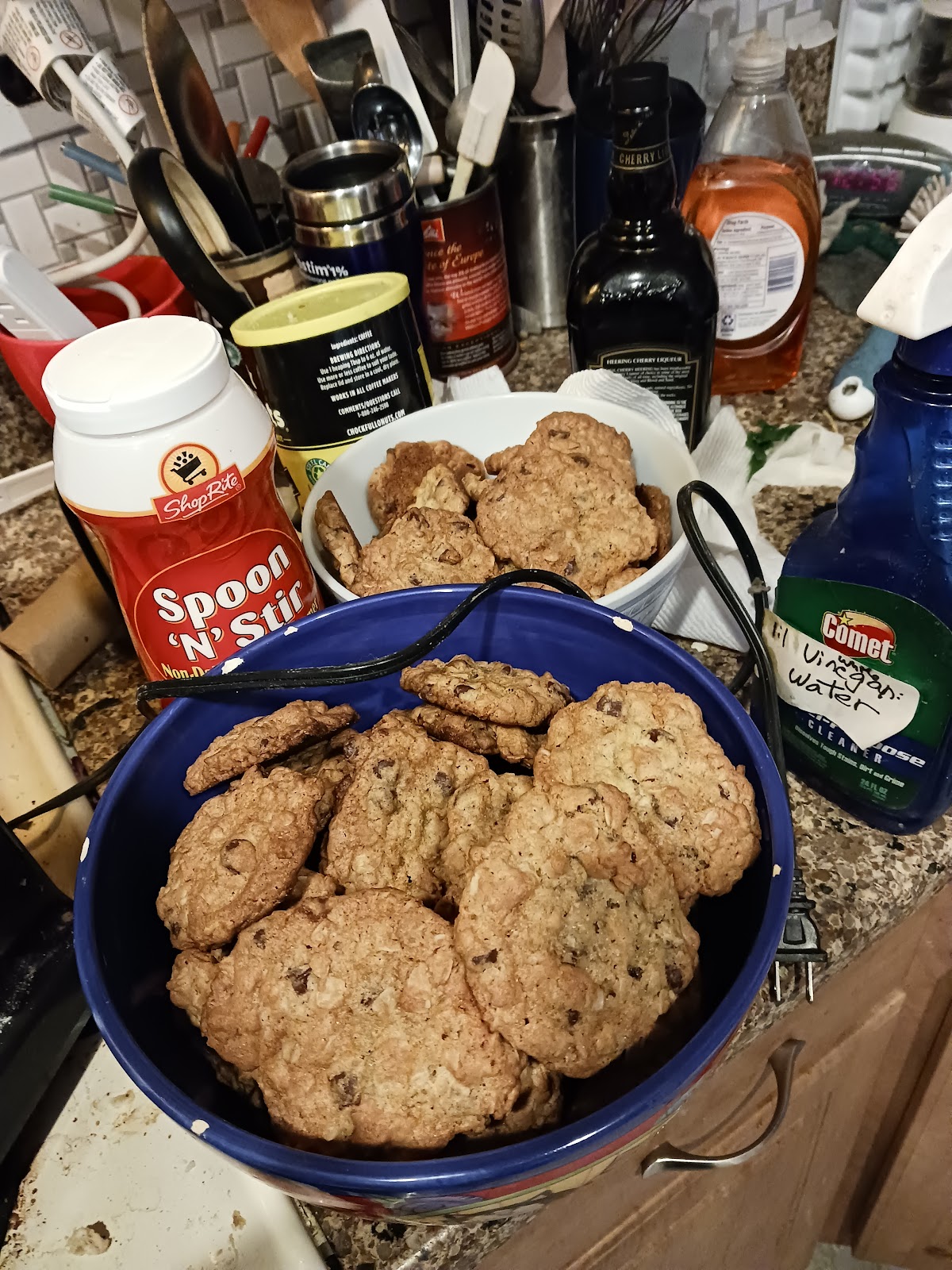
Made a batch of Oatmeal Chocolate Chip cookies, 46 of them, for our Kesher Committee to take to the Emmanuel Dining room on our synagogue's behalf. I think our turn, three a year, is on Sunday. Made in the style of Frog/Commissary, of blessed memory, a destination for my wife and me decades ago when we had reason to be in Center City. Many of the pioneering yuppie places that transformed the Philly dining scene in the 1980s to early 1990s are long gone but I still make Fish Market Apple pie and these Commissary cookies from recipes that have been preserved in print. I found that the texture is better when I use half butter/half Crisco instead of all butter. Usually I mix in walnuts, which the cafeteria did as well, but omitted them this time. Not that hard to make. Stand mixer combines everything but the oatmeal and chocolate chips, which are stirred into a rather stiff dough with a wooden spoon. Can only make about a dozen at a time on a tray, twelve minutes followed by five minutes cooling each batch, so it takes a while. Since these are for donation and they fill up two big milchig bowls, I ran out for a foil turkey roaster from the Dollar Store which should hold the entire batch, to be delivered to the head of the project tomorrow. None for me this time.

Since it is a synagogue project, there are some ethical issues. First, can I use Crisco? When it came out in the Depression era, it was advertised as Kosher as a promotion, and since pareve, it became a staple of Jewish baking and frying. However, it was originally made by hydrogenation of liquid oils to create a solid of long shelf life. The hydrogens were in the trans position, which made them among the most atherogenic foods around. The process has been revised to change the trans positions of the hydrogens but keep the shelf life, so less unhealthy.

The other issue is whether one may make what are considered luxury products for a safety net institution. The traditional Jewish view is My Food is Your Food. Sharing is mandatory and I cannot begrudge another person a treat that I take for myself. The people who run the soup kitchens do not always concur with this. They often regard their service as what the people need to sustain themselves. If they are given what they cannot realistically hope to be able to acquire for themselves, they may have been done a disservice. The purpose of places like this is so that the patrons may be able to not need it in the foreseeable future. Interestingly, this is the same view taken by Rambam in his discussion of Tzedakah. But for now, I pitch in my best effort, rugelach last time, top notch cookies this time.

Wednesday, November 29, 2023

Talmud Class


My first Talmud class in many years.  As a student, now 50 years ago, the Hillel Rabbi, who to this day I regard as my Rav, offered students an introduction to Talmud.  We had a monograph introductory text and xerox of Mishnah in translation.  I attended a few weekly classes, the oldest student there amid some undergrads, and enjoyed being there.  The class included the content of the Mishnah, but more importantly it focused on how to tease out text to elaborate not only on what was expressed but on challenges that each text invited.

Then a very long gap, decades.  My congregational rabbi now retired, decided to have a Talmud class at a long table in the synagogue library.  Artscroll's multi-volume Talmud Bavli had been mostly issued, with a few volumes to go.  This class attracted about ten men on a weeknight, all solidly experienced at Jewish liturgy, reasonably experienced at Torah, and familiar with Jewish law and how it is derived.  While not beginners like at university Hillel, only a few of the men at the table, with no targeted exclusion of women, had previous significant experience with Mishnah or Gemara as primary text.  I did not.  Artscroll produced a useful format.  The page in Hebrew/Aramaic was a reproduction of an actual Talmud.  The English translation tried to stay within that format as best as the editors could accomplish.  So we read from our xeroxes while the Rabbi retained the original printed volume in front of him as we read the original text from the big print in the center of a page, then the translation, followed by a discussion of its implications.

As much as I enjoyed it for the hour or so devoted to it, studying Talmud text this way was not something I would want to do for hours at a time as they do in yeshivot.  Our group of about ten was suitable for a small seminar, the type that the mostly professionals in our group had come to expect from previous university experience.  We all knew that the pros practiced with a personal study partner, sometimes of comparable ability though often of highly disparate experience, depending on the more capable partner to advance the junior partner.  More like a tutor than a peer.

The Artscroll Talmud Bavli sat on the library shelf, all volumes eventually translated and displayed, for many years.  It would be interesting, I suppose, to pull random volumes off the shelf, open to a few random pages, and have a Scout with a fingerprinting Merit Badge figure out who, if anyone, had even opened that page in decades.

Our new congregational Rabbi is an authentic maven of all types of Jewish sources, including Talmud.  He opted to offer as his first series, Tuesday evenings twice a month to study Talmud together.  In the years since I last looked at Artscroll's Talmud, we now have cellphone access via Sefaria.org.  We also have Zoom classroom options.  The Rabbi or his Influencers and Planners, from which I was excluded, opted to begin with a hybrid format.  It is tough to classify the mission of the class as anything but pluripotent.  Those attending live at the synagogue slurped on spaghetti with sauce before the session, bringing a social element to the program.  As a Zoomer, I was kept in the Waiting Room by the host until the discussion was ready to begin, maybe an hour after the announced starting time, though it is likely they may have capitalized on men in the flesh to have a maariv service before the pasta and sauce came out.

Notification was ample.  I had mixed feelings about enrolling, as the Influencers have labelled me a mere consumer without any role in the more fulfilling parts of project design of this or anything else congregational, something I would be dishonest with myself if I denied at least a minor element of resentment.  But the new Rabbi has made being part of the synagogue more fulfilling, totally devoid of Hebrew School flashbacks that had irritated me so, that I owed myself a sampling.

I registered for the Zoom option a few hours before the class.  Within an hour, the secretary acknowledged my interest, forwarding me the class materials.  I read all the English sources in their entirety in two sessions before the announced starting time, something that a fair number of others in attendance did not.   Despite my upper tier literacy, I found them a little difficult to follow.  There were three pieces, ranging from 1 to 3 pages each, a page of footnotes that required navigating on a computer screen.  The connection between the annotated comments and its original source found difficult to correlate.  

While cooling my fingers in the Zoom Waiting Room, those live finished their suppers and somebody let me onto the screen.  The agenda sent to me included schmooze, as connection is a purpose of a kehillah, one that I give my congregation a very mixed and sometimes unflattering review.  Zoom was not part of schmooze, and once in the room nobody really greeted me, nor did I take the initiative to offer a shalom to anyone else.  Attendance seemed about twenty, half live, half zoom.  The people the project attracted had the usual people in attendance but also a few whose presence was less ubiquitous and the dominance of Influencers that give me flashbacks of USY Cliques of my 1960s did not overwhelm.

The session began.  Questions were provided by the rabbi in advance to help focus our attention.  This is mostly a good thing, but with its limitations.  If a doctor looks at an X-ray with no hints, he will see what is on the X-ray.  If he is told that the patient has a cough, he will look for things that cause a cough, overlooking the fractured clavicle.  If a visit to the art museum presents a painting, the viewer will look at the painting's features.  If the painting has a title, like a Biblical figure, confirmation bias and attention shift take over the viewer will describe Abraham's beard or something about the city in the background being pre-devastation Sodom.  Having questions to answer while reading adds focus, but at the price of often helpful mind and imagination wandering.

Talmud is traditionally studied as a partnership, called Chevruta.  The pairs may be of comparable experience or one may dominate the other.  But for that type of learning to be effective it has to be sustained in increments over time, so that sophistication of analysis can progress.  One or two times often leaves you with a setting of pooled ignorance where nobody is really proficient but everyone is a Dunning-Kruger who thinks they are.  And that is largely what I found.  Breakout groups of two to four are easily done in person.  They are possible on Zoom but we did not go that way.  Instead, we had two dominant men among the ten with very little questioning or challenging, which is really how Talmudic study advances, even in a one and done setting as ours.  If subsequent session are still ten people on Zoom pooling their druthers, it may not be my best option for advancing my own proficiency.  And since the social aspect did not materialize on Zoom enrollment, my tenure with the group may need to be reconsidered after another class or two.

Since the Rabbi has the expertise, I think the medical model or law school Socratic method of teaching a group of that size works better for the format they have chosen.  People read the material in advance.  The expert poses a question.  People respond, either voluntarily or by calling on somebody randomly.  Others, including the expert then respond to the response and take the discussion in a new direction.  Or if you want to have Chevruta, then do that, but definitely not the illusion of Chevruta or a discussion group of ten with negligible individual expertise.

Finally, would I have chosen the topic and literature that began the series?  It was interesting, maybe a bit esoteric.  It also wandered a bit.  The original translated passage and its literary expansion were challenging to compare and contrast, as they likely had different purposes.  I think a better topic, one that comprises my past experience with Talmud, would be to select a practice of familiarity.  It could be shabbos, tfillin, why we sit for certain portions but stand for others.  All things for which we already have a personal frame of reference, for which we know the outcome of the discussion.  Then work in reverse, start with the Torah reference and follow the passages of Talmudic discussion that generate not only our current familiar practice but often purposefully reject advocates of other alternatives.  I think that would be much more rewarding than short literary adaptations of Talmudic passages, particularly those for which there really is no end resolution.

So that's my initial encounter.  I bring interest for sure.  I also bring with me a mixed expectation based on a synagogue familiarity.  Dear Therapist of The Atlantic fame realizes people come to these programs with their story already written, as do I.  Her writers usually express themselves as I'm Trapped.  I am not trapped.  OK experience for now, probably not OK experience indefinitely.  I want them to change, to which she usually responds, no you have to change.  Up to a point I'm willing, but Influencers being external to me, eventually the decision to continue becomes a very binary Y/N.  For another week, I can leave it as a Y.

Sunday, October 29, 2023

Meeting New People


Shabbos brought me to a different environment.  We have a secondary congregation, one which permits my wife and many other very talented women to enhance worship with their skills publicly displayed.  She usually goes alone, at one time leaving early to attend a pre-service class of outstanding quality with their now retired Rabbi.  His successor, a young man of immense potential, does not conduct a class before services so she gets to leave a little later.  I really did not want to be at my home congregation but I had stayed home the shabbos before.  Ordinarily my wife makes the 45-minute round trip alone, but this time I opted to go with her, driving each way, having lunch with her sister.  I even completed my scheduled treadmill session right after coffee, to allow enough travel time.

Sometimes you have to experience upwards.  If I want to enhance my wardrobe, I tour the upscale men's department.  If I want to upgrade my home, I visit a restored mansion.  And if I want to experience what shabbos might be at its best, I sidestep the Chief Influencer at my home congregation to be with different people.  Works every time.

The shabbos morning my wife seeks out is really a parallel service of a large USCJ congregation.  Over the years, the USCJ affiliates have struggled with their top-down leadership models.  They are still highly dependent on clergy for performance, abridgment of liturgy in response to congregational feedback or attendance data, and to some extent a need to have events, including a Bat Mitzvah this shabbos in the main sanctuary.  There is a grassroots, though.  There is also a large building with places other than the main sanctuary that have Torah scrolls and seating.  This congregation had that critical mass of talent intersecting interest, creating their unabridged, really less abridged, option.  And talent was on display.  No Rabbi.  No Cantor.  Each portion prepared and executed by a member of their subset minyan, all done expertly.

Having been there before, though infrequently, there were people I knew, though very few by name without a prompt from their congregational name tag worn by few, and virtually none as people with jobs, families, or avocations.  It is customary to shake hands with those who were honored or performed, which I did.  Roughly the same formality as shaking hands with my Senator, which I've done many times.  And the same formality of handshakes at my home congregation with people I do know.  It's protocol.  Occasionally sincerity, though usually protocol.  The service proceeded through its specified portions.  They gave me Aliyah #6, the longest one of that parsha, followed by the next longest, which kept me at the scroll for a while.  My wife did the Haftarah with great expertise.  The Sermon was by a congregant, some controversial content that a Rabbi would probably not tackle.  And the service ended.  Talesim folded.  Books returned to their shelves.

As we came in round tables with red tablecloths and chairs filled the kiddush area and extended out into the lobby.  A few sky blue tables where people could nibble while standing stood in small nooks at the edges of what the caterer had set up.  The main service had a bat mitzvah, with all in attendance invited for a buffet luncheon.  Making my way to their auditorium, as the main service and mine concluded at about the same time, I placed my maroon velvet tallis bag at one of the many empty spaces, the first at its table.  My wife put hers next to mine.  There were probably a couple of hundred worshipers that shabbos morning, maybe forty at my chapel, the rest in the main sanctuary.  The caterers were pros.  They set up multiple stations, three for serious eating, one for beverages, one for dessert, and one for ritual.  I started with kiddush, selecting about 30ml of grape juice, then washed hands, and took a slice of presliced challah.  The line to the food had begun to accumulate at all stations.  To promote community, the congregation created name tags for their members, kept in an alphabetized rack along the edge of the wall.  People with black lanyards and a tag were members, including the fellow behind me on the food line.  I commented on the elegance of what they had, the building, the volume of members, the diversity of ages of people present.  Very different from my usual surroundings with a forty seat chapel area and everyone on Medicare.  They had increased membership by a hundred or so households, mostly young families, attracted by their new Rabbi.  Kiddush food itself was actually very similar to what we serve on an expanded sponsored kiddush.  Bagels of different types, better than what we have locally. and pre-sliced.  Small portions in plastic of soft cream cheese, though no lox.  Fish bins with tuna and whitefish salads.  Egg salad.  Three salads, lettuce with beets, caprese, Caesar, all pre-dressed.  Roasted vegetables.  A sweet noodle kugel.  Two lines per table, Army style, moved quickly.  By the time I returned, the other seats at my table had occupants, also with full plates.  The two men next to me had suits without name tags.  Nobody with a name tag had a suit.  They were each guests of the Bat Mitzvah.  One lived in a different suburb, the other about a hundred miles to the west.  Both shared my awe with what we experienced before us.  After finishing my plate, which took a while, my wife escorted me to the dessert table where two people from our service were at an adjacent stand-up table.  She introduced me to them.  I had contacted one earlier in the week to offer a name for their misheberach list.  He had a car identical to my wife's, model and color, not sure about year.  He was apparently a journalist, an editor in the regional Jewish media.  Desserts not a lot different than at my home kiddush.  I took a cake and a brownie.  Then onward to my sister-in-law's.

Meeting new people often goes better as a visitor.  At my own place and at Chabad, I recognize everyone there most Shabbatot.  A few I keep my distance, a few I seek out for conversation.  Which depends pretty much on prior experience.  Few approach me.  Visitors are infrequent, and Rabbi has dibs on approaching them.  But as I relearned, different environments assemble different people.  Friday night on a cruise ship will invariably bring worshipers with their stories to tell, whether Messianics or couples from places where we share mutual acquaintances.  Visiting this synagogue brought me into proximity with some very skilled women who could thrive there but would be sent off to prepare kiddush at my place if the Women of Influence would tolerate unfamiliar women in the kitchen.  People had name tags, which could be an icebreaker.  Some people were dressed to the nines.  Those are Bar Mitzvah guests.  Small talk comes easily:  hometown, the food, relation to the hosts for the visitors.  For their regulars where I am the stranger, I become the figure of curiosity.  

Though I know everyone in my sanctuary, I often find it a place that makes the underlying loneliness so common to seniors more apparent.  People have already told their stories, watched the teams during the week, and don't often seem to do interesting things or have thoughts of anything really worth either an amusing or even an inquisitive response.  Not so when I worship among the less familiar.  I'll have to go again, next time as one of their volunteers.  And be more assertive to take better advantage of my own place's experience and people.

Thursday, September 28, 2023

Prominent Guest


The guest of highest public prominence ever to come to my home as a guest might have been Chaim Bloom, the recently ousted Chief of Baseball Operations for the Boston Red Sox.  His mother and my wife have remained friends.  We have been dinner guests in their rather elegant home.  Chaim got an Ivy education, got interested in baseball, particularly the statistical basis of managerial decisions, and when offered a staff position with a Major League team, latched on.  After fifteen years in progressively responsible and visible positions with his original team, he was hired by Boston as their senior officer in 2019.

Baseball's goal is winning games, starting with each individual one.  Unlike football, there are a lot of games and a lot of contingencies, so weaker teams often have their afternoons of glory.  Success, though, is cumulative, qualifying for playoffs, becoming world champions.  Statistical data driving who to put in a line-up or when to go to a relief pitcher will change the fortunes some days but not others.  Who to have on the team and how much to spend to have their contributory talent determines seasonal outcome.  

Since Chaim's ouster, dozens of news reports have come my way, first press releases, then commentary.  These have engaged my mind considerably more than the daily American political blight, as they involve analysis rather than tribalism, though The Red Sox probably have done much to create Achdus in Boston that even their political figures cannot disrupt.  First, nobody seems to think that Chaim should have been given more time to produce a winner.  In the years prior to his arrival, the Red Sox were a more successful team at season's end than while he had control.  It's perhaps a bit like personal finance, where we know we need to allot a portion of our income when needed far into the future, but we also want to go away on vacation once this year and remodel the kitchen in two years.  Chaim inherited a pretty good now, but not a sustainable now.

To get the players that can perform to the satisfaction of the region's citizens and the current team owners, he could either generate that level of skill in a minor league structure or he could purchase people by trading his talent and money with other teams or bidding for them as free agents.  And to get the success that he had inherited, his predecessors had generated a very high payroll.  League rules, designed to keep teams in big markets from overwhelming teams from smaller markets, place a penalty on overspending.  This left Chaim at a disadvantage trying to purchase the players his team needed from other teams or perhaps even the open market.  His farm system had already been depleted, ranked near the bottom by many MLB analysts.  So his task on entry was really one of restoring future capacity by reducing payroll to enable acquisition of players by trading for them and by creating a better system to make their minor league staff sufficiently proficient to promote to their major league team.  And he did both very successfully, according to the analysts' reports of his tenure.  Payroll reductions will give his successor a place at the bidding table for top performing players and other slots on the team can be filled by lower paid players with skills enhanced by minor league experience.

No good deed goes unpunished.  To reduce payroll, he traded away top-salaried players or let them become free agents.  He did a lot better at future planning than he did at the trading market for current players.  Their highest potential star, a fellow destined for the Hall of Fame, now makes big bucks someplace else but performs appropriate to the high salary.  And what the Sox received in return pales next to what they gave away.  Chaim just had a measure of timidity, a hesitation to take a high stakes bet in a game where future performance does not always match past performance.  And over four years the access to the playoffs at season's end had been lost several times in a row.  The fans and the owners wanted a competitive team now.  They could soon have one because of what Chaim did, but people questioned whether he had the boldness and risk tolerance to follow through on the high stakes trades needed to bring that about.  They judged not.

Chaim as a teenager had been a Torah reader at my congregation, as had his younger brother, also a man of immense talent, though not a public figure.  For a while we needed readers to fill in for our Cantor when away or when we were between Cantors, something beyond the ability of our congregation's men to do with that frequency, then and now.  We had teenagers ourselves and their parents trusted our level of observance, so we picked them up at the train station Friday afternoon and returned them to the train station after Havdalah.  That was some twenty years ago.

On reflection, and maybe why the reports of Chaim's tenure capture so much of my interest, is that my congregation has a similar situation, one lingering much longer than what he both inherited and addressed while head of Baseball Operations for the Red Sox.  We effectively have the men with the skills we need right now, at least in the sanctuary, though the ability of the Governance is much more open for debate.  But we lack a farm system, both in our Sanctuary and on our Board.  We have a Dominant Influencer, much like the Sox have an owner and a hired CEO.  Somebody can execute each part of the service at the time it needs to be done.  But we don't have, maybe not even seek the promotability of a farm system.  A VP has a list of who read what Aliyah last year and recycles as needed.  The Gabbai responsible for shacharit has his pitching rotation.  The Haftarah inviter probably finds it easier to default to himself much of the time.  Two new people arrived by random circumstance, not by planned development.  And all, from the Rabbi recruitment to who might have a say in future initiatives must have the approval of the gatekeeping Dominant Influencer, which has the dual effect of  bypassing some of the best minds and generating resentment in the form of expressing their free agency by non-renewal of membership or more frequently the insidious adverse consequences never getting invited to throw their energies and abilities into the mix.  So next shabbos the parts will get chanted capably, there will be herring after the services but there will also be people who resent being kept outside the gate while programming decisions and participatory invitations that never reach them for things they can do remain out of reach.  Much like Chaim, my guest and my synagogues hired but transient extreme talent from decades ago, inherited and tried to correct.