Pages

Showing posts with label Tzedakah. Show all posts

Friday, May 30, 2025

JNF Breakfast


A worthwhile morning.  Each year the Jewish National Fund sponsors a communal breakfast to support its many projects.  I have been a minor contributor since childhood.  At the time, the JNF provided blue metal collection boxes for coins.  Kids like me would plant trees in Israel for birthdays and Mother's Days, for which the JNF would issue a certificate.  When I visited Israel in 1999, I asked the tour guide why all the buildings were made of brick or masonry.  Despite these many trees of goodwill, our Jewish homeland never generated much lumber.  Even Solomon had to get the Temple's cedar from elsewhere, but he conscripted his citizens to harvest it.  Their tzedakah boxes now have a more aesthetically pleasing artistic surface, with rounded corners, but they still have a slot and do not have a lock.

The needs of Israel today differ dramatically from that pre-1967 era.  Hostility among regional neighbors remains, though not with every neighbor.  Land purchased from funds collected to create a nascent Jewish state has enabled ownership, much like our ancestor Avraham insisted on paying Efron the Hittite to establish his ownership of at least a small plot of the land that God had promised him.  Their citizens deal with episodic lethal terror, but they also have an effective military force, educational system, modern medical care, and successful commerce.  This breakfast, and last year's, addressed an obligation of Americans to make the reality of wartime Israel less of an ordeal for the people who must engage in combat while enduring global antipathy as they try to make their lives more secure.  

Last year, the JNF became my largest single charitable donation.  While the organizers of this annual breakfast plan the program around dollars, they will have to wait until later in the year for mine.  My age requires me to withdraw from my IRA each year.  Transferring charitable funds from that account directly to non-profits eases my tax bite, so no pledges from me at this gathering.  Instead, this event has an important social function, one a little different this year than last.

Who attends?  The JNF sponsors this breakfast at no charge to those in attendance, other than we pay our own parking at a nearby garage.  They rent a room in the town's most iconic hotel, some might also say most pretentious hotel.  All JNF events are Kosher.  Since they would likely get permission to Kasher the Vatican kitchen before the hotel will allow this, the organization prepares its food in a mobile facility off-site and transports it to the suite where their meetings occur.  Last year the hotel rented the JNF a larger room, one with ample room to allow people to pour themselves some coffee.  Last year being an election year, candidates also came in support of our Jewish community.  This year the alloted room had less space in a more obscure location in the middle of a lengthy corridor.  A registration table greeted us, taking only minutes.  Literature about JNF projects seemed sparse at an adjacent table outside the meeting room.  To compensate, each place setting not only had high end disposable dishes, but three informational handouts describing the organization's work.  A small table with coffee service had been placed in the back.  But the room being smaller and the larger attendance pretty much eliminated people circulating around the room and greeting each other.  The tighter space compelled people to choose their tables quickly.  Each table had food:  a bowl of bagels, trays of rounded scoops of cream cheese, lox, fruit, pastry, veggies.  A bowl of whitefish.  The centerpiece in the middle had JNF branding.  It was too tall to allow either exchange with people across the table and too wide to easily access trays of food of all types.  My chair kept bagels, lox, and the cream cheese scoops within sight and reach.  Other items were not readily accessible to add to my plate.  The bagel, slice of lox, and vegetable cream cheese made a satisfying breakfast, supplemented with the coffee I had poured when I entered.

People self-segregate into tables.  One had only members of my congregation, others people who go to other shuls.  In my working years, I could count on meeting more than five people for the first time every work day.  I miss that in retirement.  At these events, I make an effort to select a table with people I do not know.  The person next to me turned out to be an interesting chap.  We attended the same university, graduating seven years apart.  He went into finance.  He now matches private funding with Jewish organizations, mostly legacy agencies like the JNF.  He seemed reassured when I told him this non-profit stands at the top of my list.  He pressed me about other agencies, but I would not offer him a list of my also-rans.  He had an interest in our regional Jewish community.  I conveyed to him a census and analysis done by the state's Jewish Federation a year ago which outlined more entropy among our Jews over a few decades.  Population centers, once determined by the best school districts, have given way to retirement communities in places that previously had few Jews, and a shift of people whose ships had come in to some of the toniest addresses.  We agreed on some things, disagreed about the face of local and university anti-Semitism.  I think I gave him a different perspective as a small donor who practices traditional observant Judaism that differed from the machers that he usually encounters.

The speeches.  Two on what the JNF does.  As a legacy agency, its tentacles in Israel reach many places.  Our local role in the grander enterprise seems to be a focus on population shift that needs to happen within Israel for it to retain its prosperity.  The people live in metro areas there, much like Jews do in America.  Unlike America, where Jewish institutions become unavailable in the heartland, Israel's Jewish population can spread out and retain the synagogues, schools, and medical facilities that everyone needs as the Jewish presence would continue most anywhere within the country's borders, and some would take objection when a Jewish presence emerges beyond those borders.  Speeches from senior level financial and legal machers.  Worthy cause for sure.  Impression that I am being manipulated in some way?  Hard to escape the reputation these people acquire.

Guest speaker.  An Israeli-American journalist, many experiences.  Israeli Government spokesperson.  News anchor for Christian Zionist broadcasting.  Person with immediate ties to the tragedy of the October 7 attacks and its response.  Not reticent about calling the underpinnings of Hamas evil for what it is.  Credible.  Articulate. Time better allotted to her usurped by our fundraising machers with canned, rehearsed remarks.  Would have liked more question opportunities for the audience.

By the time I needed to return to the parking garage to avoid a surcharge, I had experienced a satisfying morning.  It was a little early, but I suspect the organizers in expensive suits had to return to their law firms for a work day.  Like me, people in that room had an identity to protect.  Judaism and Israel are linked, something exploited by anti-Semites who have pried the manhole covers off a subject once taboo but always present in dark spaces.  We have a successful Jewish sovereign state, strong, independent, productive.  Americans with JNF boxes helped bring that about.  I would have like to see the morning's format a little different, the hotel surroundings more conducive to mingling, perhaps even considering assigned tables so that congregations have their members sitting among different people.  Later in the calendar year, people of my age will take a day or two to allocate portions of our IRA's for noble causes, including gifts to the JNF.

Monday, November 4, 2024

My Food Is Your Food


Well, maybe not.  One of our regional heroes is an obscure Franciscan monk in the modern lineage of St. Francis of Assisi.  The current Pope adopted his name, though like all Popes he lives in splendor.  Our regional Brother does not.  He wears a hooded brown gown.  He lives simply.  But for more than forty years he has created, headed, and expanded an agency that centralizes our reach to the city's poor.  His agency provides a small amount of child care and default housing, but its central mission has been to offer meals.  For 2022, they served more than 100,000 meals.  I had the pleasure of meeting this friar many years ago when a departing medical executive opted to have his farewell reception at the agency's dining hall.  My children's Bnai Mitzvah generated sumptuous leftovers, which I transported there the following Monday.  For the Brother to accomplish this, he needs generous partners.  No group has adopted mandatory sharing of our prosperity than our Jewish community.  As community groups are solicited to take their turns providing meals, my synagogue has three sessions scheduled in the late fall every year for decades.

While this initiative should generate overflowing support from dozens of members, it doesn't seem to.  Instead, it reinforces our congregational culture, consisting of a series of fiefdoms or cliques run by and content with its few dedicated participants.  If we have good, we need not seek more than good, that view illustrates.  We can get the food cooked and served with the people we have.  They announce from the sanctuary and newsletters a few sabbaths in advance that they could use some baked goods.  I make a contribution, Kosher and in my oven, for two of the sessions, but have never been invited to join the other ladies in the home kitchen of the chairman.  

Maybe the Brother would not want me there any more than the event chair or perhaps even our Rabbi and Rebbetzin would.  There are cultural divides, perhaps even theological ones.  When I host an event at my home, kitchen experience displayed to the max most times, my kitchen output is always plentiful and elegant.  Take as much as you want.  Since we have two Challahs for Shabbos, the guest takes one home. Understandably, the friar feels this approach detrimental.  His dining center is a place of default, not celebration.  The goal for him is part rescue of an immediate situation but also a look to a future where his current consumers can become prosperous donors, able to create, enjoy, and share their own abundance.  My food is your food, eat what you like that prevails in my dining room, does not always serve people dependent on others in the best way.  The friar limits portions.  He looks at his project as a means of temporary subsistence.  While friendships and camaraderie among regular patrons likely develop, he stops short of full satiety, fearing dependence at the expense of personal growth.

While my synagogue and I each place a high value on Kosher, that same stringency is not required for the non-Jewish residents of our city who depend on the dining center for their daily, or even periodic, lunch.  And we are told that congregational members contributing food to feed these people do not need to maintain Kosher in any way.  Much of the food is prepared in the chairwoman's kitchen.  I never inquired about its kashrut.  The food is acceptable to the recipients who need it.  Yet when I contribute, the food meets the standards of my Kosher kitchen.  Should I be willing to serve a hungry person food that I would not eat myself?  Probably not as food.  Were I to give a financial contribution, there would be no restrictions on what the recipient might opt to purchase.  As a practical matter, the mission of the assigned sessions is to provide nutrition on the terms of the recipient.  It would probably not be good congregational policy to restrict baked goods donations to those made in Kosher ovens, or even with Kosher ingredients.  My food is your food, with strings attached.  Your food is not necessarily my food.  Sometimes I am the caterer, maybe a server.  Not the diner.

Our tradition has a tale of some Smart Alec asking the sage Hillel why Hashem permitted poverty when an omnipotent God could have provided adequately for everyone.  Hillel responded that God did that so people could rise to the occasion by sharing part of their larger portion.  So that is what we do as a synagogue and I do as a peripheral volunteer for that project.  Judaism seems to prefer middles.  I bake something Kosher, varying the output.  It is always created at my peak ability.  Always something that would be a little pricey for people at economic fringes to purchase from a bakery.  Always something that I've had before, both from my kitchen and high end commercially, that I especially regarded as a treat. So I share some food, restrained by the Brother's judgment on keeping his project one of nutritional default.  But in absentia and with anonymity, I also share a piece of me.  Imagination of what to offer.  Experience as a limited foodie.  The Brother cannot restrict that.

Sunday, February 25, 2024

Sacred Cows No More


My communal stock must be ascending.  Last year's Federation Super Sunday phone solicitation came from a pleasant functionary of no standing reading a script.  I stopped the script, bantered a bit.  He had neither the experience nor the wit to respond to my unwillingness to be part of any formal Federation Campaign since I dropped out in 1995 following an adverse experience with some of their people of title who did not make it quite to the midpoint of my patent pending Jewish Dignity Meter.  Indeed, a couple annual solicitations later, usually from some very nice people who I knew well who did not read from a script, I just opted for their Do Not Call list, which they respected for about another 25 years.  I never elaborated on my experience, which I assess at the intersection of dishonesty and cruelty even decades later, nor did anyone ever solicit the story.  One of the downfalls of Leadership Modeled secular, or perhaps even Orthodox Judaism, is the assumption among the proteges, imparted as part of formal Leadership Training, is that disgruntled people must be ingrates or in some identifiable if not obvious way, inferior and not worthy of what the Leadership offers.  And that assessment probably began in my Hebrew School years, persisting to this minute.  And attrition over those sixty or so years hints that my assessment is accurate.  There is a form of Leadership Generated Attrition, and my response to my own experience provides just one more illustration.

What I did instead, though, as my wife's hand shook from verbal threats conveyed by telephone from a titled critter with leverage over us, was to personalize my own Judaism.  By this time, The Jewish Catalog had issued all its volumes, each widely read.  Much of the population figured out that they could have shabbos without the synagogue, vacation someplace other than Grossinger's, support Soviet Jewish emigration, and learn enough Hebrew external to the darlings of the day school to acquire proficiency on the bimah.  Shabbos does not have to start with candle lighting and end with havdalah.  It could start with kiddush.  If breakfast out can only be done on Saturday morning and the camaraderie of the diner's counter exceeds any spiritual benefit of shul, then shabbos concludes that morning.  Or maybe it doesn't conclude if the activity is special to Saturday morning.  I am commanded to share my treasure as Tzedakah.  That treasure is not so large as to run any agency when donated or harm any agency when withheld.  I can walk away from the venal Rabbi's if I wish and redirect my communal allotment to a Jewish nursing home, an independent advocacy group, a school, a museum, a place from my past where I found acceptance exceeding what I experience now.  

If machers need to mistreat somebody, I'm the right person.  I can handle it.  I can walk away.  Mistreating somebody captive, whether my wife, a struggling child, a friend, or somebody who I see as vulnerable doesn't cut it.  And while I did not walk away, I took control, personalized everything.  I changed shuls.  And as the Federation solicitors learned today, I repackaged my entire tzedakah program.  As I approach thirty years of doing this, there have been very few revisions, mostly to enhance amounts and number of recipients, to move money away from my synagogue in the direction of my own Jewish past and what I think my parents would have found a more meaningful destination when their yahrtzeit's arise.  My kashrut standards have become more strict.  My shabbos more traditional.  Some Sacred Cows Schechted, primarily ones that define leadership and remind me of a USY clique.  Those memories are long past, some of the hurt of exclusion remembered then and felt now.  But opportunities for engagement as technology has enabled niches and interaction not previously available to me.

Ironically, last year and this, Federation solicited me because I had resumed making a donation to the communal umbrella once again.  A three digit figure, not the four digit amount somebody anticipating a move to a higher leadership title would donate, or shake somebody else down to donate.  They mistakenly thought I was back in their whirl.  Last year's call came from a functionary, this year's from a very experienced participant guiding a newer participant.  I made it clear, that my tzedakah initiatives, which now include their agency as a beneficiary, is still my creation functioning successfully for nearly thirty years.  Make a pledge?  No.  Need a reminder a year after my last credit card authorization?  No, my process works just fine.  Back on Do Not Call list?  One less call to make, one less disheartening rejection for the caller.

In good times and strained times, I've known virtually all the people who have had me on their Super Sunday call list.  A shabbos or two before each designated Sunday, Rabbi's announce the event from their bimahs, sometimes with a reminder to their congregants, that if a kid calls avoid being harsh with them.  I've never been strident, even in those horrible years of the early 1990s when I opted out.  I simply asked for my pledge card, which their operatives were instructed by their Fundraising Chairmen not to send, but always relented when told it would be no money unless I filled out the amount myself.  Then it arrived in the mail shortly thereafter and was returned with a check, whose decreasing amount reflected more my irritation than my prosperity.

I've never been called by a teenager.  Some are angling for acceptance by their group, others for something assertive to put on their college applications.  I do get called by students of my two alma maters, part of their obligation to obtain financial assistance to attend.  I do not pledge money over the phone.  Send me a note and they will get something.  And I fulfill my end.  How would I handle a teen who is being told that soliciting funds for a worthy cause is part of one's worthiness of Jewish leadership?  I would never tell my tale of woe.  I would tell what I what told the very experienced solicitor, who is himself often a personal irritant, though in a different way.  Giving money to Jewish causes is a Divine commandment that I fulfill.  I have a successful way of assessing amounts, destinations, and times.  Creating that process, tweaking it periodically, and moving on from unhappy experiences is also part of being a successful Jew.  The ability to do that and maintain it for thirty years has value to me far in excess of any title the community might offer.  The Leadership curriculum may hint that people licking their wounds are inferior and deserved those wounds if they were real at all, not just perceived, are defective in some way.  I'm not defective.  Just deprived of kindness when my family was vulnerable.  I learned not to do that.  And while that teen will go away without the pledge she seeks, her rabbi need not warn me to be cordial when the call arrives.

Thursday, January 4, 2024

Baking for Synagogue Committee


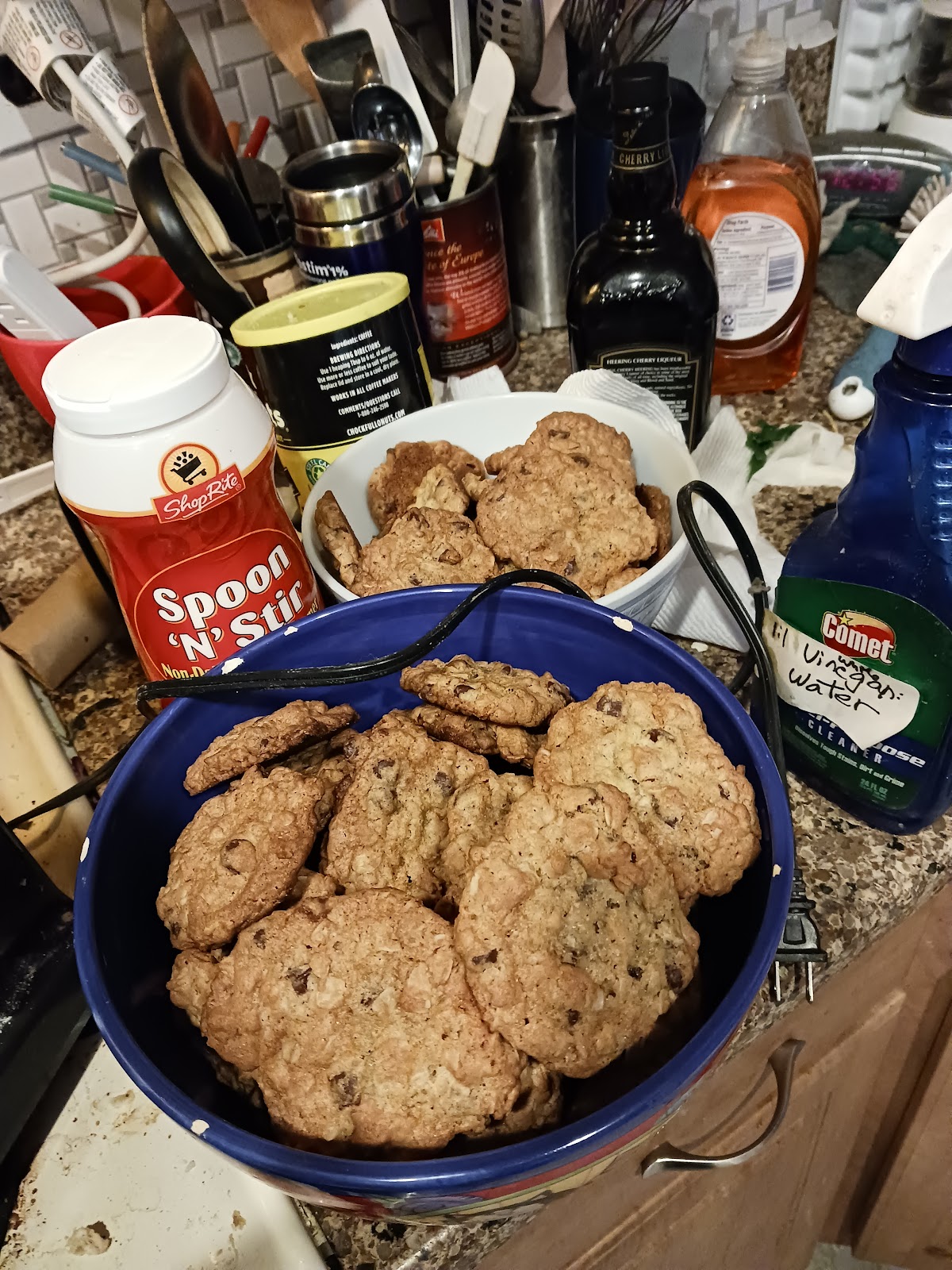
Made a batch of Oatmeal Chocolate Chip cookies, 46 of them, for our Kesher Committee to take to the Emmanuel Dining room on our synagogue's behalf. I think our turn, three a year, is on Sunday. Made in the style of Frog/Commissary, of blessed memory, a destination for my wife and me decades ago when we had reason to be in Center City. Many of the pioneering yuppie places that transformed the Philly dining scene in the 1980s to early 1990s are long gone but I still make Fish Market Apple pie and these Commissary cookies from recipes that have been preserved in print. I found that the texture is better when I use half butter/half Crisco instead of all butter. Usually I mix in walnuts, which the cafeteria did as well, but omitted them this time. Not that hard to make. Stand mixer combines everything but the oatmeal and chocolate chips, which are stirred into a rather stiff dough with a wooden spoon. Can only make about a dozen at a time on a tray, twelve minutes followed by five minutes cooling each batch, so it takes a while. Since these are for donation and they fill up two big milchig bowls, I ran out for a foil turkey roaster from the Dollar Store which should hold the entire batch, to be delivered to the head of the project tomorrow. None for me this time.

Since it is a synagogue project, there are some ethical issues. First, can I use Crisco? When it came out in the Depression era, it was advertised as Kosher as a promotion, and since pareve, it became a staple of Jewish baking and frying. However, it was originally made by hydrogenation of liquid oils to create a solid of long shelf life. The hydrogens were in the trans position, which made them among the most atherogenic foods around. The process has been revised to change the trans positions of the hydrogens but keep the shelf life, so less unhealthy.

The other issue is whether one may make what are considered luxury products for a safety net institution. The traditional Jewish view is My Food is Your Food. Sharing is mandatory and I cannot begrudge another person a treat that I take for myself. The people who run the soup kitchens do not always concur with this. They often regard their service as what the people need to sustain themselves. If they are given what they cannot realistically hope to be able to acquire for themselves, they may have been done a disservice. The purpose of places like this is so that the patrons may be able to not need it in the foreseeable future. Interestingly, this is the same view taken by Rambam in his discussion of Tzedakah. But for now, I pitch in my best effort, rugelach last time, top notch cookies this time.

Monday, November 27, 2023

Giving Tuesday

Holiday season has arrived, with its pluses and minuses.  Turkey partly eaten, partly carved and frozen for subsequent meals.  Thanksgiving fleishig dishes nearing completion of hand washing.  Kids' Hanukkah gifts wrapped.  Black Friday was once a day in which I would get up very early, pick my bargain from the plethora of store ads that accompanied the Thanksgiving morning newspaper, and make a bee line for my selection, usually a gift for my wife's birthday that follows the holiday by about a week.  No interest in this day for a few years, though this year I drove my daughter to the nearby Farmer's market where I indulged myself in a slice of pizza and a piece of crumb cake, then picked up a few bags of candy at their dollar store.  Cyber Monday of no interest, but it probably beats people scouring the stores, large and small, for just the right gift while they crowd the parking lots.  That brings us to Giving Tuesday.

Already every organization that I ever visit or donate to, other than my synagogue, has automated its request for contributions on that day.  My email teems with reminders that tomorrow has been earmarked for supporting non-profits of various types.  Social agencies, the arts, alma maters, advocacy groups, even political candidates.  There is a lot of money to share and mostly good causes to share it with.  And it helps that people are now starting to consider reducing some of their tax burden next spring.

My own Tzedakah process has been semi-automated for decades.  On a certain day each month, I give a fixed sum.  The destination is set in advance for some agencies, others vary over the course of the year.  I think it's a better system than a single day each year with reminders from worthy causes, and a few questionable ones, dominating the subject line of my email Inbox.


Tuesday, January 25, 2022

Writing an Extra Check


Made some donations though a few days behind schedule.  My wife donates small amounts to everyone, which I found out when I logged our December expenses onto Excel.  Mine are done monthly, one moderate one to a Jewish cause each month, once with a note of appreciation to the agency to accompany the check, now for efficiency online.  A few times a year I have targeted contributions independent of the monthly ones, some large enough for IRS documentation, usually in October.  Then as Social Security made my income rise a bit, I added a secondary Jewish donation, a small amount to an agency that does special things.  And there are yahrtzeits, condolences, and other occasions that generate contributions.

It takes place on the 20th of each month, or thereabouts, with delays for shabbos or having some uncertainty of where to contribute.  Two special checks went into the mail, both to support the good work of old friends.  One became a minister of a semi-rural church in picturesque New England.  They have online services each Sunday that appears on Facebook.  This week they had a financial appeal.  I sent them something.  This being the approach of yahrtzeit, I always send a contribution to the current version of my mother's synagogue, long since repackaged, where her memorial plaque hangs.  I learned last year that a high school friend remained in the area, attends that synagogue, and started collecting small toiletries and other items to distribute to the homeless.  I sent a second check for her use.

All better destinations than lying fallow in my checking account.

Wednesday, December 1, 2021

Solicitations to Spend

While retail has had some turmoil, we still spend money in substantial amounts right after Thanksgiving.  Our promoters offer us Black Friday, Local Saturday, Cyber Monday, and now Giving Tuesday.  No shortage of invitations to any of these.  While there are many worthy non-profits, I think yesterday's Tuesday left me saturated with solicitations.  One of the best things I ever did for myself and a select number of non-profits has been to make my Tzedakah systematic, distributing a certain amount on a certain day each month.  Cyber Tuesday just got out of hand.  Maybe move it to Palm Sunday.

Monday, February 24, 2020

taking charge of my tzedakah obligation

https://www.yutorah.org/sidebar/lecture.cfm/945434/rabbi-mordechai-torczyner/running-tzedakah-like-a-business/

yutorah.org has a plethora of stimulating lectures that keep my mind sharp past retirement.  There's a category called machshava, or thinking, that I like as well as history.  Over the years of listening to these podcasts, a few teachers stand out.  Talks that approximate one I might have attended in college attract me most, those that recall Hebrew School get turned off quickly.  Rarely do I feel personally involved.  Often I think of some type of question, which suggests I am really listening.

This one on Tzedakah connected personally, more than most, since I made a transition in fulfilling this mitzvah about 25 years ago.  I had wondered for a long time if I was right, particularly when prompted by a personally adverse Jewish communal experience, yet had never run my decision by any Rabbinic authority just assuming they are more attached to their agenda than to researching the principles of tzedakah to match how my approach conformed with traditional interpretations of our Sages or ran afoul of them.  Rabbi Torczyner, a prolific yutorah.org lecturer with attention to source detail, gave cyberspace with me in it the overview that I lacked the skill to seek on my own and the trust to appoint an agent to research what I had done.

Some background.  I remain observant despite taking a few lumps from leadership, a member of the synagogue, a refugee from a previous synagogue and for the most part a defector from Jewish communal activities.  As Mayor Bloomberg advised the graduates at my son's commencement, I have made my best attempt to promote my own INDEPENDENCE/HONESTY/ACCOUNTABILITY/INNOVATION.  In fact most of these require little special attention on my part, though at the price of kehillah sometimes.  I have lived in my community for about 40 years, not exactly wandering in a Jewish desert or seeking some other setting.  Like most mammals, I seek food, protection from predators, and a commitment to reproducing.  Ordinarily that herd provides protection but for some it is the source of one member imposing dominance on another.  I was not alpha.  I also eventually found myself in the anti-herd situation of having to protect offspring.  Not having too many herds around, I divested myself of the ones with the most predatory machers.  I could be useful at times, an irritant at times, but never unconditionally valuable.  There are other people to whom I could be unconditionally valuable.

Uneasy relations go back a long way.  As a bar mitzvah era camper at an esteemed Jewish summer camp, the head counselor assembled our group the day before departure.  He noted in his remarks that about 10 kids had gotten too homesick to stay.  Among his remarks were that those people were not the caliber of person this camp and the Jewish institution it represents really seek.  There was something inferior about them, some impediment to their being groomed as future leaders of his Movement.  I didn't want to return the next year, not experiencing anything close to an Ace summer,  and told our Rabbi who had a lot of his professional training invested in that camp.  I became inferior too, convenient when Torah needed to be chanted at shabbos mincha but somebody whose loyalty to his Movement was not absolute.  University participation in Jewish life was voluntary.  Since nobody had expectations or an enduring agenda, whatever I opted to do met with Hakras haTov, something not captured since.  It may be the only ongoing stretch that nobody of title berated me for resisting what they thought was their due, my fulfilling my part of their mission.

My medical degree opened many doors.  It also generated some perceptions, not always true.  Being in a new community, Jewish, a skilled bimah participant at my new shul from the outset, and a young person whose income could only rise and whose ability to pay day school tuition for future offspring at their day school would reinforce their agencies brought more invitations than I was used to.  Camp revisited:  we want you here because of what you can bring us.  We just have to show you the Federation Way.  So I started going to meetings which sounded a lot like what the head counselor, who by then had become a Seminary Dean, imparted.  They were the umbrella organization.  No challenge on my part to how that benefits a community.  Every Jewish community of any size since the Middle Ages has had elders dispersing alms or stabilizing institutions.  Help us raise funds at the next phone bank session.  OK.  They gave the two dozen of us best and brightest a script which sounded too much like a shakedown of people I didn't know to actually read, and felt the same way.  I substituted my more dignified approach, that which the person who called me the previous winter had used.  If somebody offers me $100, my inclination is to thank them.  The script said not to, ask for $150 instead.  They called husbands and wives separately.  I got to call the husbands.  I had a joint account, not a very full one, and my wife and I share the big expenses.  I am not about to give a large amount knowing that she might be shamed into giving more than we should.  As I called with no interest other than being a dutiful agent for a worthy project, I got quite an earful for resentment.  And they told us younguns, never offer to send anyone their pledge card.  When they called me the next year, I asked for my pledge card and got a lot of resistance from a very experienced participant.  My lack of specific amount would impair their planning, he told me.  I responded, then put me down for zero.  The Federation will get more than that from me if they send the card so they can do even more than was planned.  He really did not want to write zero on the card, so he sent it and I mailed off a check.  Of our two dozen high prospects, attrition was high.  By the time I waved soyonara fifteen years later, my original cohort depleted to a couple of pushy attorneys who fit in a lot better than the docs and engineers.  I guess they are imprinted to see challenges as opportunities for negotiation.  I saw the experience as one more manipulation in the name of Jewish leadership.

Opting out of this aspect of communal Judaism does not negate my obligation to help the poor and sustain institutions.  I replaced this with a more business-like approach to tzedakah, one with more purpose than being amid the herd.  I took the sum that I had donated to the umbrella, added 50% and divided six ways.  On the 20th of every even numbered month, I would send a check along with a card or note expressing thanks to the special mission of each agency, sometimes with a Hebrew citation of why their work sustains Judaism.  My first check went to a Camp for special needs Jewish children who, like my own son, found themselves outliers.  That first year, I got four phone calls from agency heads thanking me for my good wishes and usually a hand written note added to the acknowledgement letter.   As the years went on, my prosperity advanced so the frequency of checks rose to every month and the amount increased, so that the annual donation became several times what I would have considered giving to a communal umbrella that made me uneasy.  Donating became a form of kevah, setting a time.  It also became a time of exploration.  No agency's fortunes depend on whether I give that year so from the outset I began exploring what is out there to support.  Some agencies are large and impact on how we all live as Jews.  The local Family Service gets the January donation each year, since rescuing the needing of our county has tzedakah priority over everything else.  Children of Entitlement at our day school, a place that gave me more tzuris than any other affiliate agency when my outlier son came knocking, have other means of support.  I like universities and museums, some relatively obscure.  Friends of the IDF shows appreciation to young people on a difficult and dangerous mission, not always voluntarily.  It is my obligation to offer them some assistance.

As time went on, checks and notes became less efficient ways of collecting, perhaps adding to overhead that detracts from what can go to beneficiaries.  The notes from the directors to my note all but stopped as money collection became more mechanized.  This year for the first time I yielded and went electronic.  The agency heads will no longer have their Hakaras HaTov  from me, only their funds.  They will just have to assume my personal esteem for the good they do continues tacitly.

So how did I do?  Not bad according to the principles sourced in Rabbi Torczyner's presentation.  Better to give a lot of small disbursements rather than one big one.  There are coins for the pushkas at minyan, emptying loose change from my pocket into my home tzedakah box, various fundraisers that crop up.  It's better than a big pledge on Super Sunday and the Yom Kippur Appeal at shul.  Every month has a 20th day.  I have to think about what must be the best destination for that month's donation and what about that recipient adds to the mosaic of Judaism that we need to sustain.  Bypassing the umbrella has its own merit, though in retrospect it might have been preferable to depart for opportunity rather than resentment.  On the other hand, we have contemporary Judaism because participation has to be repackaged periodically, whether replacing a central Temple with scattered synagogues, allowing the Hasidic tzadikim to supply a spirit that was previously inadequate, and rethinking the roles of women.  These days we have our Jewish None's, including a fair amount of leadership generated attrition.  Our head counselor could not have been more in error.  Those who were disappointed by his camp were not inferior, nor are the millenials defecting now.

Finally, the sources presented hinted that tzedakah needs to be businesslike in its efficiency and predictability but not at the expense of personal attachment.  That matters a lot more than the size of the checks.  Not at all the message I got from my high potential Young Leadership invitation nearly forty years back.  The decades seem to have confirmed the error of that message and what might have generated more committed enthusiasm among some really talented people.

Image result for writing a check


Sunday, January 26, 2020

Super Sunday's Defector

Last week I gave a public seminar on Jewish attrition which is really a subset of religious attrition.  It takes many forms, and unless one is among those Church Centered people that Stephen Covey, z"l, so vigorously downgraded in his 7 Habits, we all probably have some element of this.   I've been on Federation's Do Not Call List for 25 years and I do not expect a solicitation today.  Indeed, many Federations and other fundraising organizations have written off their small donors as not worth the effort or the telephone earfuls that their contributions would bring.  I've not forsaken tzedakah, quite the opposite, just fired my agent for doing this in 1995 and brought this vital initiative In House.

I think the attrition from Judaism that we see now is really Leadership Generated Attrition, the just deserts of how people see themselves as being treated, whether accurate or not.  Of course those machers told each other how wonderful their leadership efforts were.  Defectors were by definition, inferior Jews or ingrates.  Probably not true then and not true now as their leadership clones who have taken up the baton look at how to make the best of their current circumstances.

For me, the experience violated some of the most basic needs of the Animal Kingdom.  We all devote our efforts to looking for food, avoiding predators, and reproducing.  I gathered food and a good deal of professional and personal satisfaction externally to the herd, found a fair number of predators from within, and had to protect one of my offspring.  Even looking at the herd for the security and opportunity it provides, the losers of the rut who are put in subservient positions may start seeking a different herd where they can flourish more effectively.  That's me.  That's a lot of people.  It's not everyone.  They'd have real tzuris if it were.  The disaffiliation composite speaks for itself.  The rut through which the people of title emerge will just have to engage smaller herds.
Image result for jewish federation super sunday


Wednesday, August 13, 2014

Disbursing My Treasure

When I put myself of Federation's Do Not Call list fifteen years ago after some experiences that justified my becoming one of the Pew Research Center Study drop-outs, I did not pocket the donations but distributed them myself, first bi-monthly for a couple of years, then monthly until last year, and now quarterly, though monthly was better.  Quarterly allows me to spend too much time on my figurative High Horse from which I tease out relative worthiness and themes.  So last quarter I sent checks to support Israel's security and Jewish camping to the neglect of people in my community whose lives are currently a little more precarious than mine.  So this quarter it looks like the checks will go to forms of outreach, some religious, some social.  I think randomness of support, or really inclusivity of support, better reflects the concept of Tzedakah, so I think I will return to the previous format next month

.

Sunday, December 23, 2012

Donations

Being more prosperous this year than in the past, I opted to increase the amount of my monthly Jewish donations by about a third each.  Prosperity comes at a price, meaning work, fatigue, and some lack of control over my schedule so as we approach the end of the calendar year, what used to be a monthly contribution to some worthy organization had atrophied to two checks written to unique institutions that are on my perennial list.  On returning from vacation, I took out my checkbook and some note cards sent to my by organizations that thought they might get a contribution in return and started began consolidating a very fulfilling project spread over the year into two days.

Of all my private accomplishments, restructuring my approach to Tzedakah gives me the most satisfaction.  My current mechanism now approaches nineteen years but its origins trace to my early days in Delaware, some thirty years, or half my life.  There is no question that Judaism requires generosity, sharing a portion of what is earned or even not earned, as the mandatory half-shekel per person was still required of the poorest among the population.  As an intern, I was subpoenaed to court as an expert witness by the Commonwealth of Massachusetts for having taken care of a star witness in murder trial.  As a surprise, the court gave me a $25 check for my testimony, which I tried to give back since my hospital contract specified no outside income for my first year.  The chief recommended I have a nice dinner for my legal ordeal.  Instead I deposited the check and wrote another to the Hillel Foundation of St. Louis which now receives my single largest contribution each year.  Hakaras HaTov remains a core value as well.

While Jewish agencies do valuable work and the people who dedicate themselves to it merit a measure of credit, organizationally they often do not comport themselves in the best way, and for many probably should not have Jewish as the first word in their banner.  It did not take long for the local Federation to get my telephone number and ask for money.  The first solicitation was from a friend, perfectly dignified and honest.  When we spoke about amount, it was far in excess of what I was prepared to give so I offered what seemed more within my means.  He thanked me, did not bargain over amount, and I sent a check for my pledge.  The following year, a new Executive Director arrived, setting up a Young Leadership division to which my wife and I were invited.  It did not take more than a couple of orientation meetings and presentations to realize that the people were much more interested in my professional title and the income it would be expected to bring over time than they were in the intellect that brought it about or any ideas and talents of Judaism that my wife and I or anyone else in the program might possess.  And the machers there were the machers of my synagogue who before long would swoop down and run a Rabbi who I admired out of town.  As part of the program the participants were expected to man the telephones on SuperSunday, the day volunteers go to the phone banks and ask members of the community who are not prima fascie megadonors for their annual pledge.  As novices we were given a card with what they gave last year, a script to read that asked for considerably more than they gave last year, and how to bargain for something in the middle if they balked at the suggested amount.  I put the script aside, following instead the format of the friend who had solicited me the year before.  I knew these people would give something, usually about what they usually give.  I said thank you immediately and made no suggestion of amounts.  When another member of the program called me, the solicitor read from the script.  I found it just as offensive to hear as I would have expected from reading it, told him so and asked him to send me my pledge card, something the trainers said to make every effort to resist.

First impressions count and these guys did not endear themselves to me.  They separated husband and wife, asking each independently for pledges rather than as a family, even though finances are often bundled, including in the script why each has to give as an individual rather than a family if anyone being solicited desired a single family pledge.  As a physician, I got invited to non-kosher brunches with no kosher option at McMansions where en route the police track my car as one not belonging in that neighborhood.  Certificates were distributed to physicians whose only serious connection to Judaism was their income, though I suppose in a religion where one's actions take priority over what one thinks, their generosity is to be properly acknowledged irrespective of background or motivation.  So this remained my own forum for tzedakah, along with they synagogue for fourteen years.  I received a call each year, declined to pledge a specific amount over the phone but promised to send a check after I receive my pledge card which I did promptly.  Some took exception at not knowing the amount but I stood firm.  They can record it as zero if they really needed to know for planning purposes, then when the check arrives they will have a little extra.  While I did not particularly like this organization, its Executive Director became a personal friend from synagogue.  He meant well and eventually insisted that the solicitation be less of a shakedown of small donors.  The real money comes from the machers.  The good will of the public should not be jeopardized over attempts to get another $50 a year from people who already thought they were being fair to the community.  While I long since divested myself of Young Leadership, where attrition was expectedly high, and I often held the movers & shakers in private contempt, I also knew that social agencies needed support, there has to be an Jewish educational system in the community, there are many overseas needs in Israel and the former Soviet Union.  All these are best addressed as pooled funds which are then distributed by grants to individual agencies that carry out the actual work.  The people doing this were annoying but not evil. Over those fourteen years, as my income increased my pledge rose as well.  When my income declined as I went from staff physician to Endocrine Fellow to new solo practitioner, I kept the higher contribution.   But the loyalty never jelled.  Once an identifiable malignant Federation type accruing public honors arrived on the scene and affected me personally, the perspective would change forever.

There is an entry in my personal journal from October 1994 that I would not give to Federation in the future. Apparently by the Jewish Federations of North America analysis, the figure of those solicited who rebuff the solicitation is about 15% nationally.  At the time I was irate over adverse experience.  I shared my thoughts with my wife and we maintained a united front on this.  The pledge call came to my wife and I separately as scheduled in January, requested by a personal friend who I greatly admire.  We politely dropped out for cause, asked to be put on their Do Not Call list which did not happen for another year, declining to elaborate on why when asked so as not to attack a community leader.  The Executive Director, who attended our synagogue as well, came over to me one shabbos shortly thereafter acknowledging our desire to drop out, not challenging it in any way, though I suspect that acceptance would be different if our contribution had another zero or two appended to what we actually give.

So now I have a rather large sum of money to distribute as a religious obligation and no agent to do it for me.  I also have a somewhat hateful, contemptuous view of the Jewish leadership to dispel.  Like most things, it is less the bad apples themselves but the tolerance of the bad apples by the good oranges.  Much the reverse of Sodom which was destroyed not because of evil but because of the paucity of good.  But it was time to move on.  I took my annual pledge, added a little to it, and decided I would distribute one sixth of it every other month.  Included in each contribution would be a note of Jewish values explaining why I found that agency's projects an essential component of Jewish life.  My first contribution went to an organization called the Round Lake Camp.  They had taken out a small ad in the NY Times Magazine inviting Jewish campers who were felt unsuitable for the Ramahs and Galils of the Jewish world.  In a Jewish world that often regarded you as convenient or inconvenient instead of intrinsically important in one's own right, here was an agency that reached out to parents like us who found themselves rejected and isolated.  I sent them a check and a brief note.  They sent me a personal thanks penned to the IRS acknowledgement and later a video tape of their campers having a blast.  Two months later my secretary asked me to take a call from the president of the Jewish aging home.  He had received my note and appreciated the thanks that was conveyed to their staff and volunteers who get a lot more complaints than praise.  And so it went for most of the contributions and accompanying thank you notes.  Agencies big and small.  Camping, Family Service, disaster relief, education.  Since I have a local obligation before world obligations I left the Kutz Home and Family Services as annual constants, including some Biblical, Talmudic or liturgical reference as to why these projects are vital.  Later I added another constant, an organization called Footsteps that serve Haredi young people who wish to partake of other aspects of Hashem's social offerings.  These people through no fault of their own never got the education or earning skills that were made readily available to me.  They are often shunned by their own community when one of the core Judaic principles may be to accept people as you find them and help them develop in their own way.  I have been a permanent beneficiary of two Hillel Foundations that functioned by this principle.  Over the years, influenced by positive feedback from the agencies, my bimonthly donations became monthly donations scheduled on the 20th of each month just as I would pay any other periodic financial obligation.  Sometimes I was late but until this year, never had to bundle contributions to meet an IRS calendar benefit.

Since only three annual donations recur, this project over eighteen years has taken me to every imaginable activity that Jews do for each other and for the world.  Money is gathered to alleviate disasters.  There is an agency called American Jewish World Service that sends emissaries, my daughter among them, to volunteer for basic living development in poverty areas of Africa, Asia and Latin America.  Israeli professors get Nobel Prizes for lifetime efforts.  The Universities that sponsor their work depend on Friends of Technion, Weizmann Institute et. al.  For the Israel Defense Forces to have a form of  USO, they also depend on American Friends.  We have Hillel Foundations and Chabad that allow people not yet absorbed into our culture to enter.  We have a history, a collective memory, that endures through its museums.  And we have members of our community, too bothersome for those who are destined to "make it" and therefore left extrinsic to it, who are served by people of special sensitivity who advocate on their behalf.   There is an extraordinary organization known now as JACS which serves the chemically dependent.  It was intended to be a synagogue branch of Alcoholics Anonymous but rejected by several congregations whose officers and clergy did not want shikkers in their building.  It's prime motivator, Rabbi Twerski, a chasid with a medical degree who is one of the world's pioneers of addiction therapy, has a series of books on self-help and non-medical Jewish thought published primarily by an organization called Artscroll, whose parent organization, the Mesorah Heritage Foundation, frequently gets one of my contributions for translating primary sacred sources so that English speakers can read them.  And there is even a place for some benevolent Tochacha.  From time to time I send a check directly to the Jewish Federations of North America with a brief note of why it goes there rather than to the local agency and a recommendation that they use the resentment that the machers often produce to provide other suitable outlets that keep the victims engaged after they vote with their checkbooks and feet.  There is no end to the good that can be found if you seek it out nor any way that the brief notes of thanks that each receives from me adequately compensates their efforts.  It does compensate me in a very large fashion.  My approach to what Judaism stands for has never been the same.

This year's list:  The Kutz Home, Jewish Family Service of Delaware, Footsteps, American Jewish University in Los Angeles,  Friends of the IDF, American Jewish Committee if I can find their street address which they have conspicuously omitted form their web site to mail the check, Chabad of Delaware, American Physicians Fellowship for Medicine in Israel which sponsors Israeli physicians to receive training at American and Canadian Universities, American Friends of The Israel Museum, Masorti Foundation which promotes a Conservative Jewish presence and Jewish pluralism in Israel, the Hebrew Immigrant Aid Society,  and the American Jewish World Service.  And outside the list comes two other substantial contributions:  The Mesorah Heritage Foundation based on its importance and the Hillel Foundation of St. Louis whose Rabbi  left a permanent imprint on what I should be aspiring towards.

Next year's list will undoubtedly differ but the principles will not.  With some effort I will be able to remedy the lapse in timeliness.

Friday, September 3, 2010

Shabbat Prep

End of the work week, end of the summer.  Very early on Friday morning with a few tasks separating me from a shabbat respite, or if not a respite, then a change of pace.  I made the foundation of dinner:  flanken and Israeli couscous with sauteed onions and mushrooms.  Then some cauliflower to parboil before lichtbentschen.  When I get to the office, I will put my coins in the Pushka, then bring the pushka to my car, as this is the final Friday that I expect to be in my office.  Maybe I will empty the Pushka, put the coins in the TD Bank coin counter and write a check for the proceeds to the Hebrew school like I usually do at the start of their school year.  It will probably be the final tzedakah check from my office account.

On Fridays I do a double portion with my Franklin Planner, outlining both Friday and Saturday anticipated tasks.  I also think about where I will attend services, usually Beth Emeth for Kabbalat Shabbat and AKSE on Shabbat Morning.  This week I also need to pick up some mini-challot, either from Trader Joe's or Safeway.  Come the end of the workday, the tasks will close, the majority typically not done, to be half-heartedly restarted when the sun goes down Saturday and more vigorously shortly after sunrise on Sunday.

While shabbos is different, is it really better, as people tell me it should be?  Definitely a difficult question to analyze, but for now I'm content just leaving it different.